On J♥5♠2♣, I called a bet with 8♥6♦. I had eight-high, and the baseline solver solution folds this combination. Yet in another analysis, I showed why even top pair can be a fold against a particular range.
The key for me is understanding human patterns: how an individual opponent simplifies the game, and the shortcuts people tend to take more generally. Someone may happily raise every strong pocket pair, then bet almost every overpair. In a wide limped pot, that same person may bet weak hands and check middling ones. Those habits change ranges in different directions, and my response changes with them.
How the hand played out
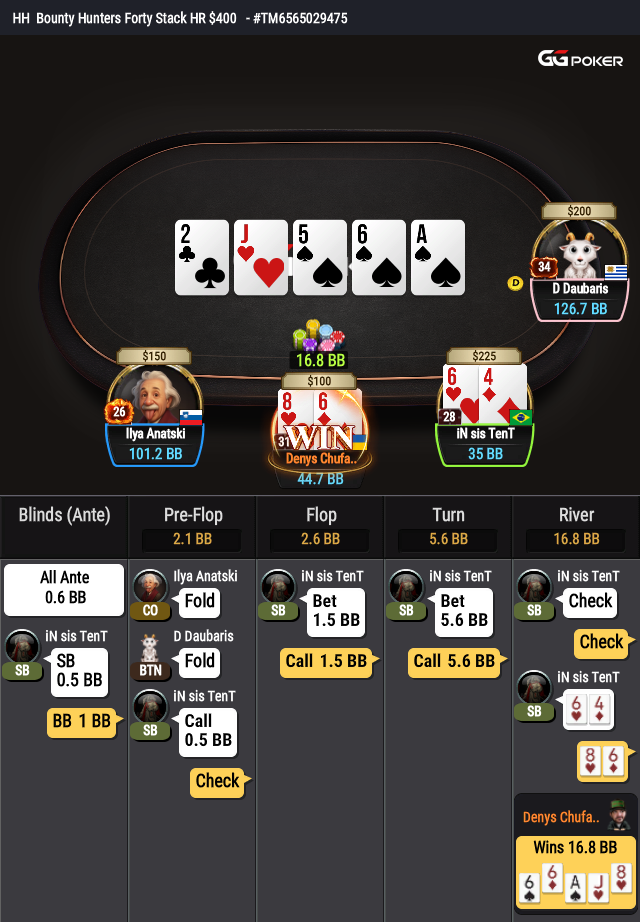
In the $400 Bounty Hunters Forty Stack HR, everyone folded to the small blind. My opponent limped, and I checked 8♥6♦ in the big blind.
On J♥5♠2♣, he bet 1.5 bb into 2.6 bb. I called. The turn was the 6♠, and I faced a pot-sized bet of 5.6 bb. I called again. We both checked the A♠ river. He showed 6♥4♦, and my kicker won the 16.8 bb pot.
The most interesting decision, though, is on the flop. Turning a six and winning the pot prove nothing on their own. I need to explain the call using what I could reasonably have expected before showdown.
Before looking at the flop
For a reference point, I opened a similar PKO spot: around 40 bb in the small blind, with the big blind covering slightly. The solver mostly limps 64o and sometimes folds; at the displayed precision, limping and folding have the same EV.
Our actual conditions were different. My opponent had a $225 bounty and mine was $100, while the total antes were smaller. Given those conditions, I lean towards folding 64o preflop. That is my assessment of this particular spot; the displayed solution does not establish a mandatory fold.
I also found something useful for my own game: the solver raises 86o quite actively against the limp. I checked in the hand. Raising and checking have the same rounded EV in the model, so there is no reason to label my check a mistake. Still, I want to account for that aggression in future. Bounty incentives may matter here, although we do not yet have a separate chipEV comparison.
On this flop I would simplify
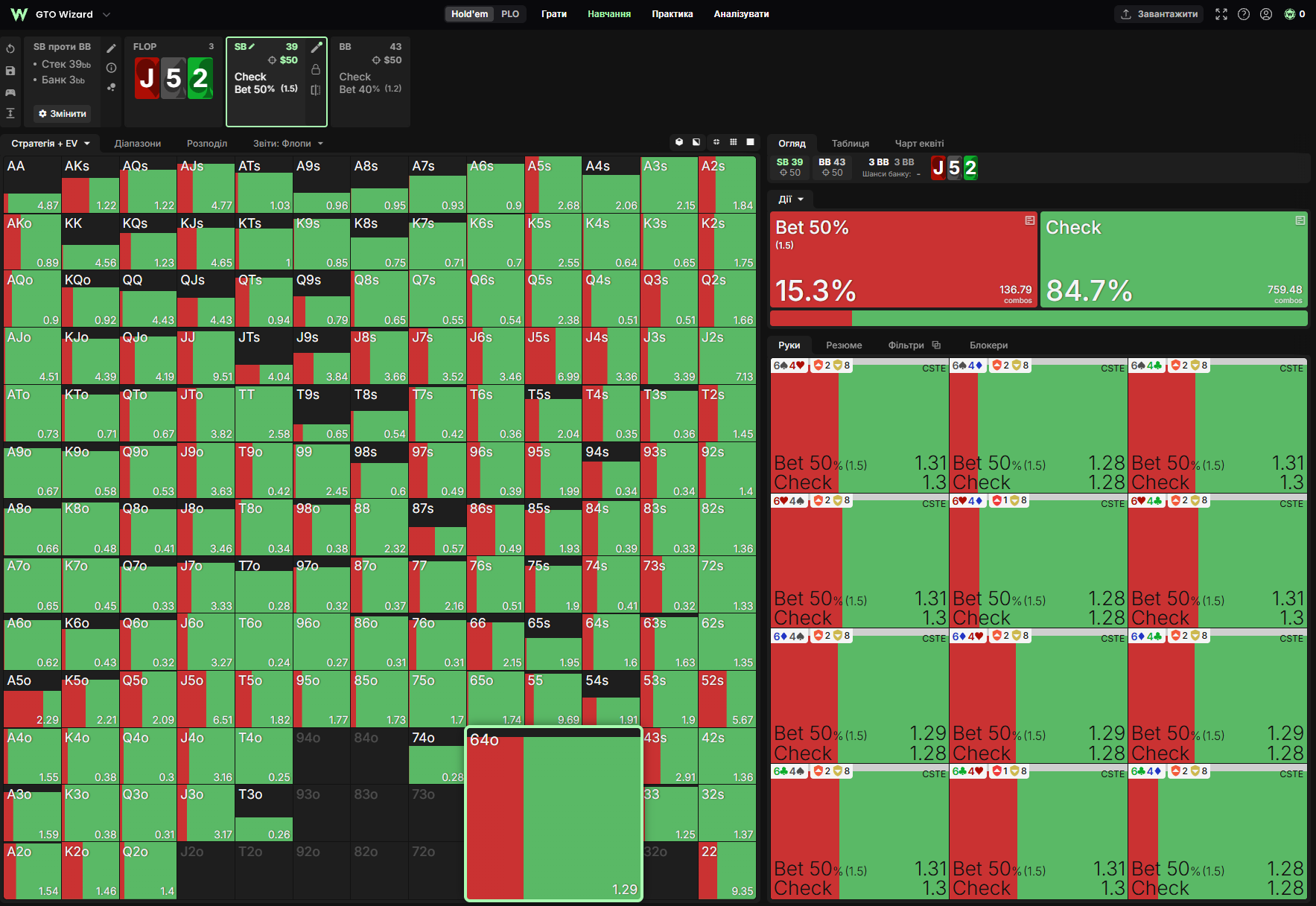
I used the same 1.5 bb bet as in the hand. In the baseline model, the small blind bets only 15.3% of its range and checks 84.7%. Some 64o combinations also mix in bets.
In practice, I would prefer to check my entire range here. A small betting range is difficult to construct and then play correctly on later streets. I find that simplification more manageable than trying to remember a handful of infrequent bets. I would consider the same approach on many similar boards, without automatically applying it to every flop.
It matters how we reached this spot. The small blind limped and is out of position. A habit of betting frequently as the in-position preflop raiser against the big blind can easily mislead us here.
Why the solver initially folds 86o
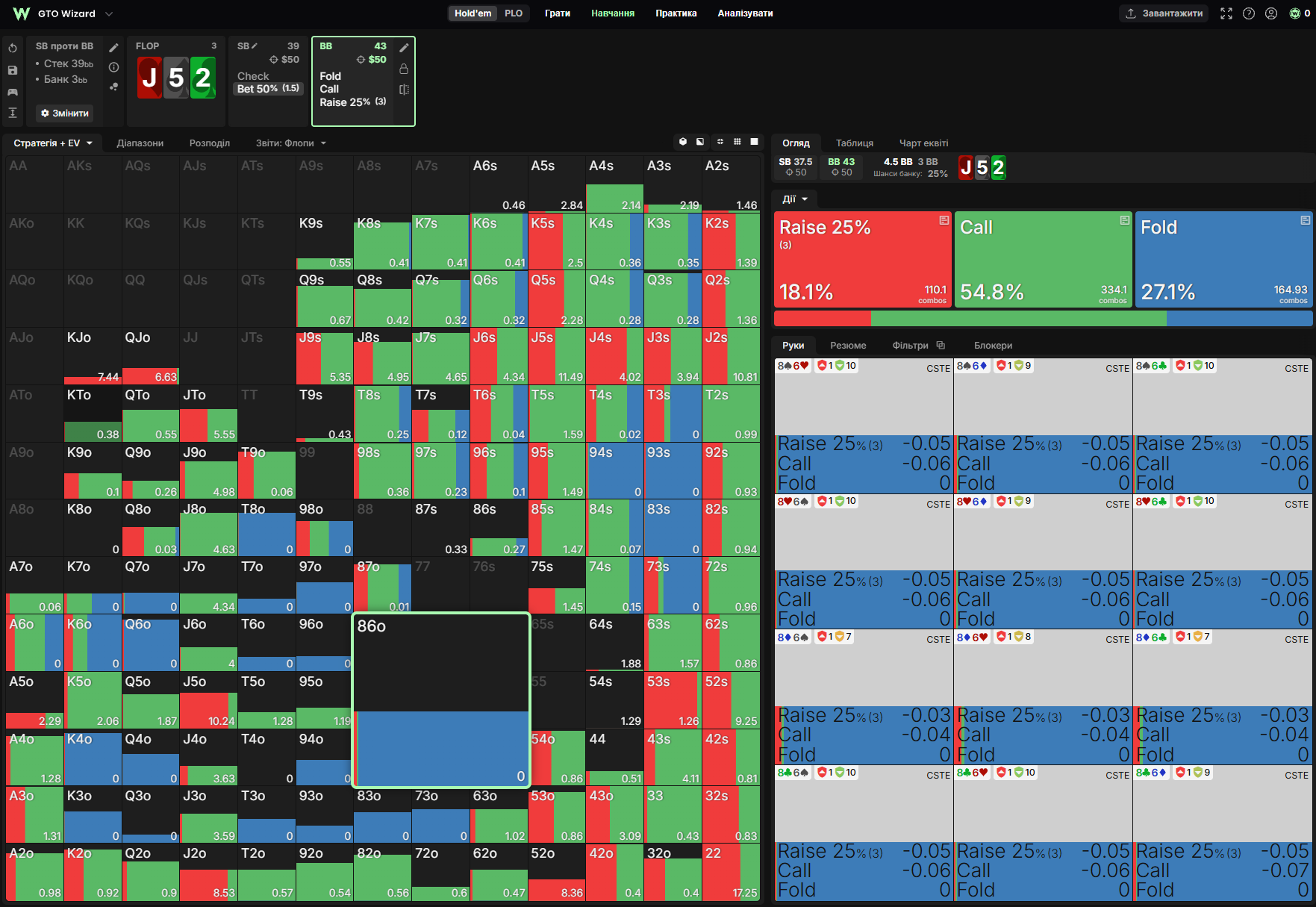
Against that carefully constructed betting range, 8♥6♦ folds. There are not enough additional weak hands in the opponent’s range for my eight-high to continue profitably.
At the table, however, I was working with a different picture: I expected my opponent to bet much wider. That is why I called. I also expected mistakes later, whether too many turn check-folds or overly wide barrels.
That is an assumption about his strategy. Seeing 64o at showdown does not, by itself, reveal his overall betting frequency: the original solver solution sometimes bets that hand too.
Changing the betting range
To illustrate the effect, I locked the small blind to bet its entire range. This is a deliberately simple experiment, not a claim that my opponent literally bets 100% of hands.
After recalculating, 86o continues: mostly by raising, sometimes by calling. For my exact 8♥6♦, both actions become positive relative to folding. The solver prefers raising, but calling now looks very different from the baseline result.
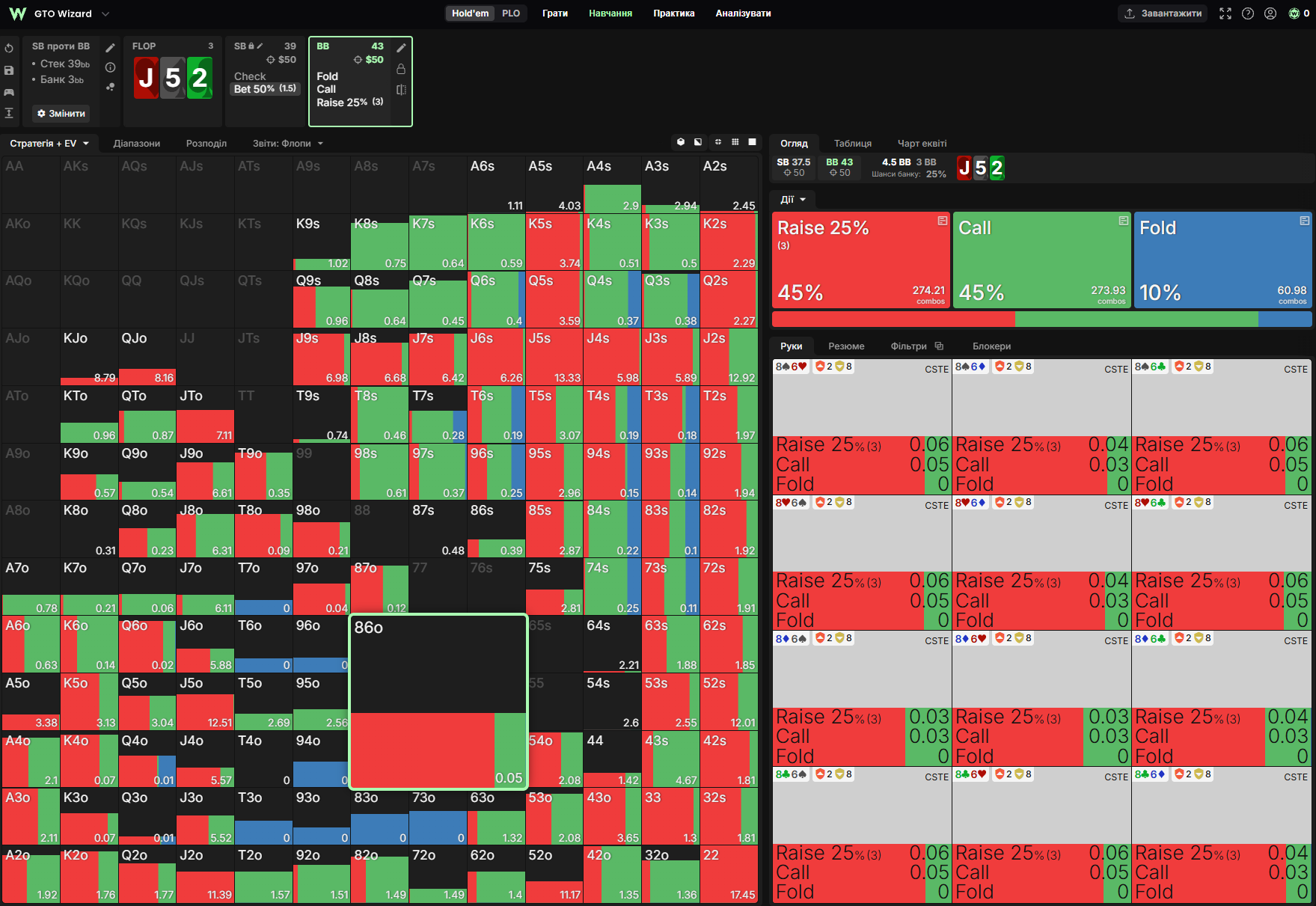
In an actual game, I want to understand how the person chooses which hands to bet. A wide limping range contains many combinations that are difficult to distribute between betting and checking. A natural human shortcut is to try to win the pot with a bad hand and check a middling hand with showdown value. Weak hands such as 63, 64 and 67 then appear in the betting range more often, while some middling hands remain in the checking range. Calling with eight-high becomes much more appealing against that composition. The opponent still has value bets, of course; the balance between those hands matters.
The experiment’s positive call value already includes subsequent play within the model. My expectations about extra check-folds and barrels were not tested separately here. We should not present the calculation as confirming those additional mistakes.
How this connects to the hand against Larin
The kings-versus-T7 analysis illustrates a different human pattern. A solver may raise KK only at a low frequency, while a person is much more comfortable raising every combination of kings. On the flop, they may be just as willing to bet almost every overpair. Within a narrow small-blind raising range, that significantly increases the proportion of strong hands that continue barreling. Against that assumed range, the big blind’s marginal top pair starts folding on the turn.
In this hand, the starting limping range is much wider. If a player sends many weak hands into the betting range and prefers checking middling ones, the familiar shortcut has the opposite effect: my eight-high has more reason to continue. That is why I want to understand both an opponent’s individual habits and the common ways people simplify these decisions.
Read the kings-versus-Larin analysis
For me, this is the essence of SHMiTO and poker: study the solver’s logic, then become a kind of “solver in your head” at the table. Keep refining your estimate of an opponent’s range through their actions, sizing, frequencies and habits, starting preflop. Then look for a response to that range. I cannot know it exactly, but I can revise my estimate as new information arrives. That is how I can find reasons to call with eight-high in one spot and fold top pair in another.
Model note. This is an illustration rather than an exact recreation of the tournament: stacks, bounties and antes differ. The 1.5 bb bet is 50% of the model’s 3 bb pot and approximately 58% of the actual 2.6 bb pot.