I turn the nut straight. There are 13.4 big blinds in the pot and my opponent has almost 69 behind. Seems like a good time to build a pot, right? I check back.
The plan is a little cheeky: show weakness to a very strong player and give him a chance to attack it. I don't know whether it will work. But this feels like the spot to try an idea that's been sitting in the back of my mind.
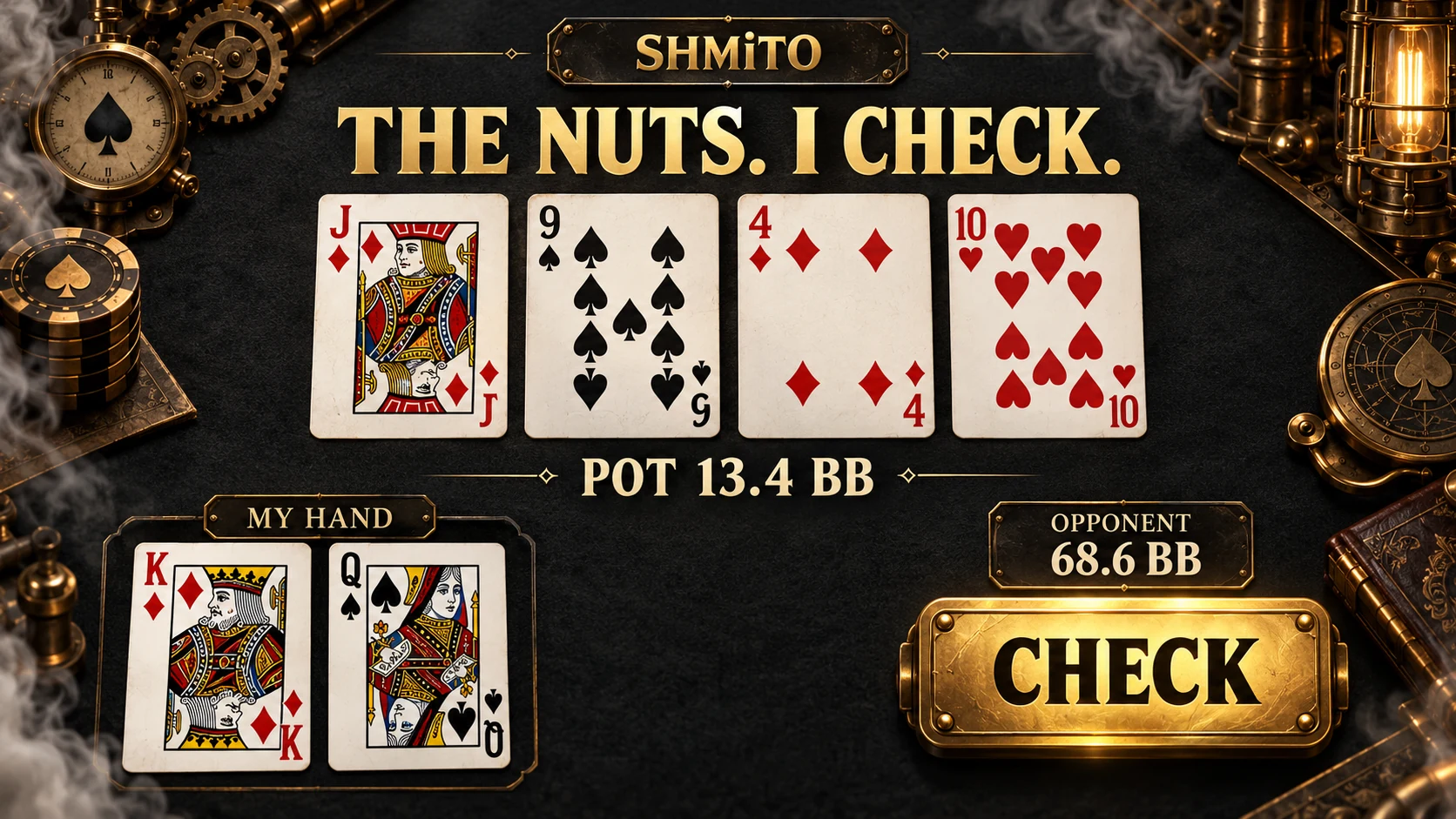
The setup
We're playing a phased $10,000 GGMillion$ event on GGPoker. Late registration closes in less than an hour. I have around 80 big blinds and a top-five stack. Those chips already mean something to me. I want to make it through, and I don't need to start a huge battle with another big stack without a good reason.
Alisson Piekazewicz, the well-known Brazilian high roller, is in the cutoff. I rate him very highly, which matters throughout this hand. He has 73.5 big blinds. The small blind has around 50 and the big blind roughly 36. My read is that the big blind is a recreational player.
I'm on the button with K♦Q♠. Alisson opens to 2.3 big blinds.
Preflop: why fold out the hands I dominate?
I'm choosing between calling and three-betting. I can three-bet some of the time, but I lean towards calling here.
One reason to three-bet KQo is to avoid getting squeezed into an awkward spot. I don't expect the big blind to squeeze very often here. He can also call and join us postflop, where I'll have position.
There's another consideration. If I three-bet, Alisson may fold hands such as KTo, KJo and QTo. Hands my king-queen does well against disappear, while AQ and AK, which dominate me, stay in his range.
With that particular reasoning, I'd look at QJo as a three-bet candidate. Getting KQ or KJ to fold is a pretty nice result for that hand. Of course, it depends on what he actually folds. This isn't a universal rule that QJo is always a better three-bet than KQo.
I call. The big blind calls too. Three of us see the flop.
Flop: choosing the combination
J♦9♠4♦.
Both players check. I expect Alisson to check a very wide range in this multiway pot, including good hands. His check doesn't mean I can just fire away with everything.
But my particular combination has some useful properties. The K♦ removes some diamond flush draws, and the Q♠ removes some possible backdoor spade combinations. If I'm deciding which KQ combinations to bet, that interests me. I also have a gutshot to a ten.
My thinking is that I remove some of the combinations they can comfortably continue with, making this king-queen more appealing to bet. That's a read on specific ranges, not a rule that holding a blocker automatically creates more folds.
I bet small. The big blind folds, Alisson calls, and we're heads-up.
Turn: once in a blue moon
The T♥ lands. I have the nuts.
The pot is 13.4 big blinds, with 68.6 behind for Alisson. The obvious starting point is to bet for value. But if I bet around 10 and he calls, then bet another 25 into roughly 33 on the river, I still haven't won his whole stack. Bigger bets or a raise could get more money in. That ordinary two-bet line won't do it by itself.
Then I remember an idea from short deck. Sometimes, very rarely, you can check back an extremely strong hand against someone who can smell weakness and really attack it. He may decide your check means you have very few strong hands left, and start applying pressure.
Alisson is exactly the kind of player I could expect that from.
I didn't get this line from a solver. It comes more from accumulated experience: I've been in similar situations, thought about this line and wanted to try it. Here, the opponent, the stack depth and my hand seem to fit. The diamond king is part of my reasoning too, removing some of his possible flush draws.
Of course, checking gives him a free card and can cost me value. But this time I want to give a strong player a chance to attack my supposedly weak range. I check back.
The river is the 7♥. The board reads J♦9♠4♦T♥7♥.
The flush draw misses. Any eight now makes a straight, while my KQ is still the nut straight.
Alisson checks. So the first version of my plan, getting him to lead big, doesn't happen. Now I want a size that a weak hand might pay off and a stronger hand, such as an eight, might at least consider raising.
I bet 8.8 into 13.4.
He raises to 67.6 big blinds, leaving himself one big blind behind.
Okay. Now we're talking.
I put him all-in for the rest, and he folds. We don't see his cards, so I'm not going to invent a specific hand or blocker for him. But almost his entire remaining stack is already in the pot.
Why I was so happy
You can see my reaction in the video. I'm absolutely buzzing. Winning a huge pot is nice, obviously. But what makes this one special is seeing an idea I decided to try actually work.
I chose a very strong opponent, took a line that could look weak, and got a massive raise. Usually, when you come up with something this clever, it doesn't turn out quite so beautifully. This time it did.
One hand doesn't prove that checking the turn is better than betting. We'd need to examine ranges, frequencies and alternative lines to make that claim. My hypothesis was simpler: if an opponent attacks this check-then-bet sequence too aggressively, keeping the nuts in that line becomes more attractive.
That's what makes poker interesting to me. You know the familiar line, but you look at the person in front of you and ask: what opportunity can I give him here?
Sometimes the answer is to check back the nuts and see what he does with it.