Losing a 150-big-blind pot hurts. But this hand left me with a useful question: how much does a turn decision change if an opponent bets strong hands on the flop more often than the solver does? My kings against Larin illustrate why we need to track a range throughout the hand.
How the hand played out
I had K♠K♦ in the small blind with around 85 bb. Larin had about 75 bb in the big blind. I was eighth out of 64 players, with roughly 91 minutes of late registration remaining. Both stacks were large, so the prospect of playing a huge pot already deserved some attention.
I raised to 3.5 bb and Larin called. On T♠9♥2♦, I bet 10 bb into 8 bb: 125% pot. He called. The turn was the 5♠. I bet 21.8 bb into 28 bb and he called again. On the T♣ river, I checked, Larin shoved, and I called. He showed T♦7♦.
The final pot was 753,500 chips, or 150.7 bb. That is about seven and a half starting stacks. Of course I was disappointed. But the result alone says nothing about the quality of our decisions. We need to assess them against the ranges we could reasonably consider at the time.
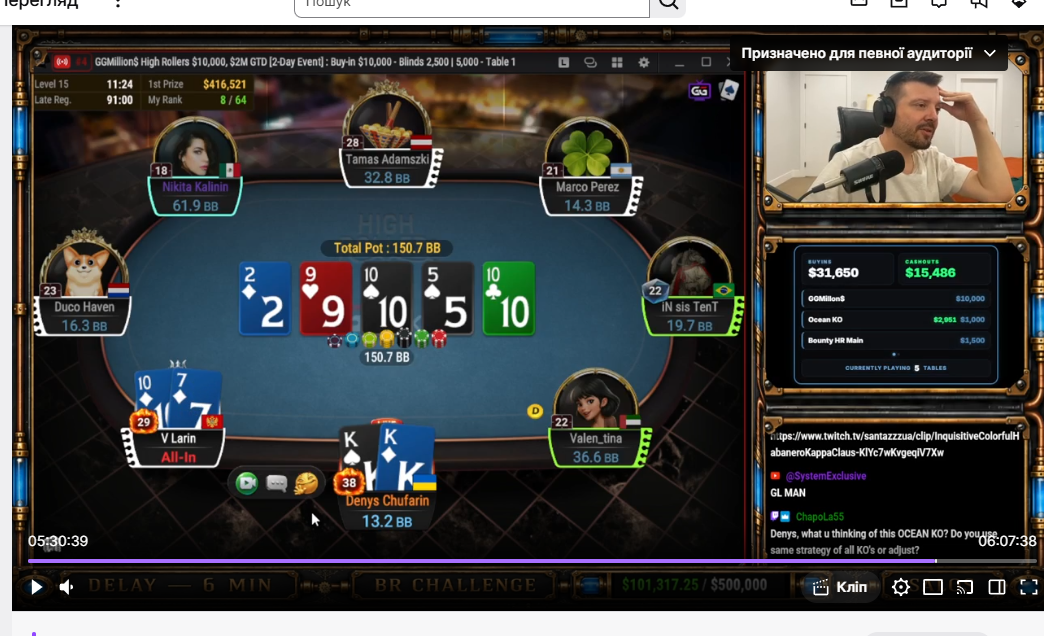
Watch the hand on Twitch from 5:27:55
What the baseline solution shows
In the GTO Wizard model I selected, the small blind raises only around 10% of hands. Kings raise at a low frequency and limp much more often. That gives us an important starting point: a narrow range reaches the flop.
On T♠9♥2♦, I wanted to bet my overpair big. We are out of position, stacks are deep, and the opponent has top pairs and straight draws. The solver checks frequently; when it bets, it more often chooses 168% pot. That does not make my 125% sizing a major error: the EV difference between those options is small for kings.
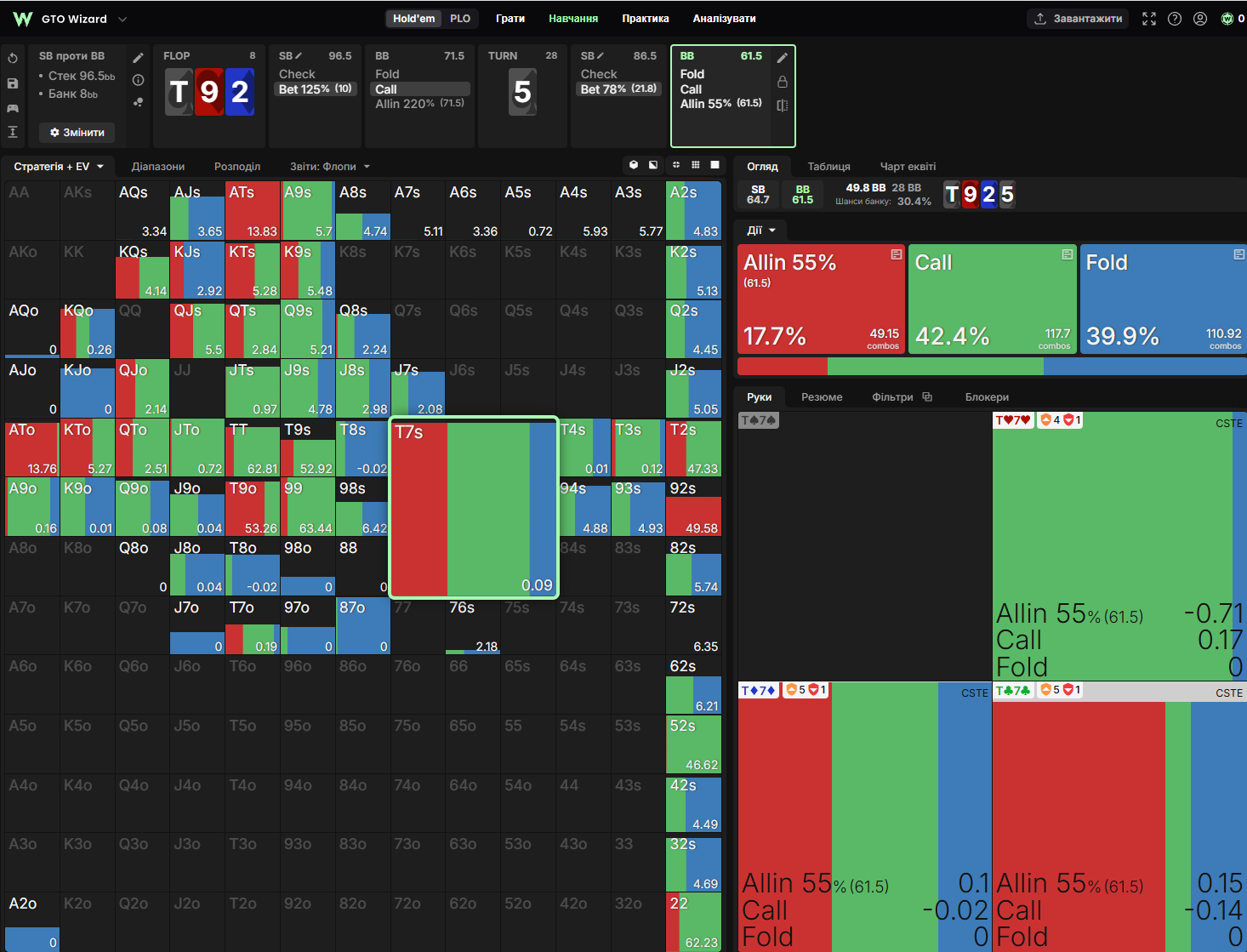
To analyse the line we actually played, I selected the 125% branch. In the baseline solution, calling the flop with T♦7♦ has an EV of about +1.84 bb. Against my turn bet, its call EV is around −0.02 bb: effectively on the boundary between calling and folding. The baseline alone does not justify calling this defence an obvious mistake.
On the river, we should not judge kings solely by the trips we eventually saw. The call depends on the entire shoving range, including its bluffs.
The range can change before the flop
The solver often limps strong pairs, whereas I might raise them almost always. Within a narrow raising range, that gives much more weight to hands that will become overpairs. On the flop, I am also more inclined to bet them than to check. A stronger range may therefore reach the turn than in the baseline solution. We need to account for that difference from the start of the hand.
What changes with a different flop strategy
To test the effect of betting overpairs more frequently, I started on the flop. I kept the original preflop range for this experiment.
I used a node lock, which fixes part of the strategy, to send overpairs into the flop betting range more often. After recalculating, the turn call with T♦7♦ had an EV of about −0.73 bb. A hand that was borderline in the baseline now loses a meaningful fraction of a big blind. T7 and T8 fare considerably worse against this range.
The reason begins on the previous street. When more strong hands enter the flop betting range, they also feed into the turn range. We cannot assess the second bet while ignoring how the opponent got there.
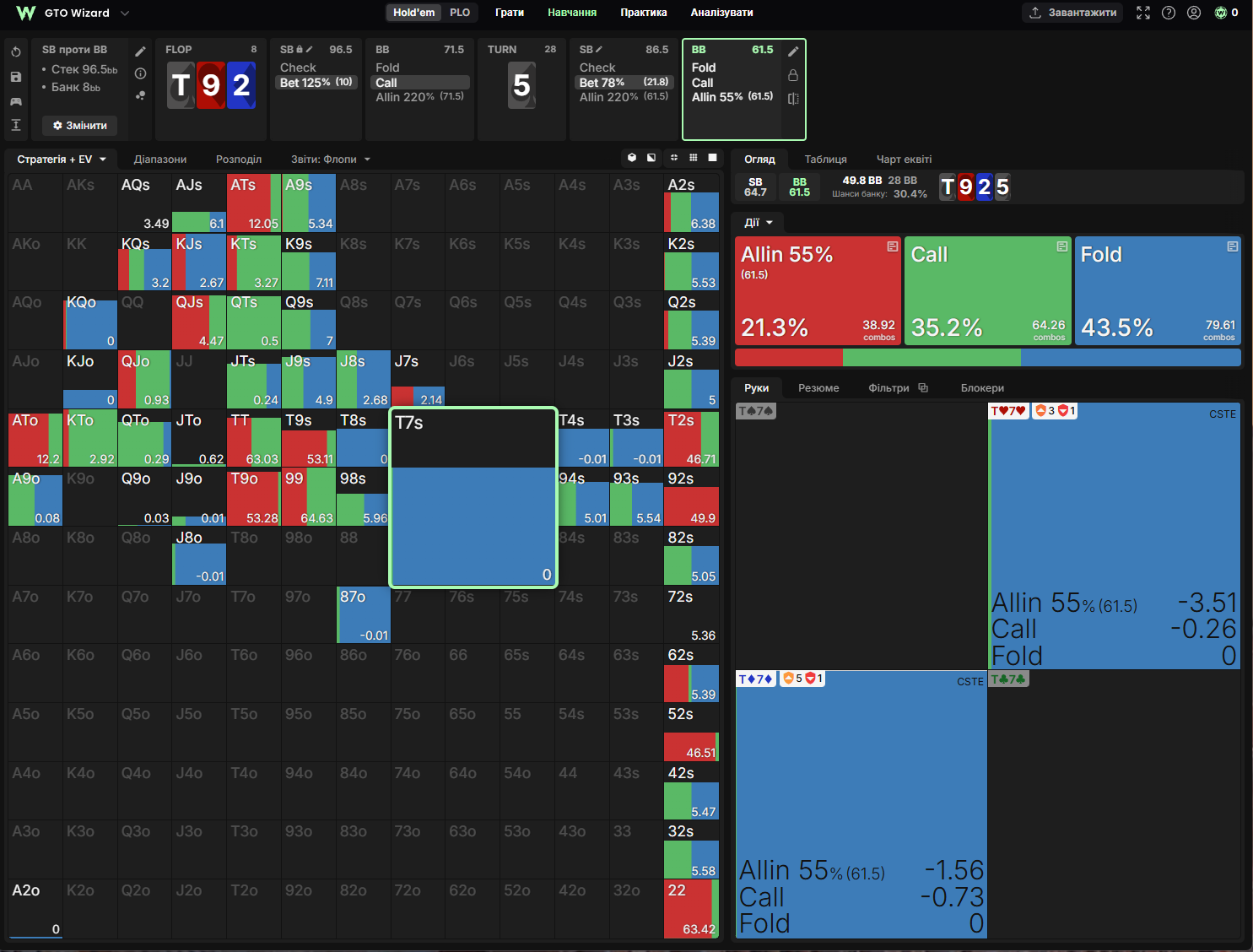
This experiment tests a specific hypothesis about my strategy. It does not prove that Larin should have known my range, or that everyone plays overpairs the same way. The model is also approximate: the preset stack depth differs from the actual hand, and the exact tournament pressure is not reproduced.
What I take from this hand
Before defending top pair on the turn, I want to answer three questions: what range did the opponent bring to the flop, which hands went into the first bet, and which of those continue now?
Our experiment makes the point tangible: give the solver the stronger range you expect from a real opponent, and it folds the top pair it was defending a moment ago. The range it is facing matters.
There is a practical consequence too. An early marginal call can lead to an expensive river mistake against an opponent who underbluffs. That is why we need a plan for later streets now. The turn call's EV already accounts for the model's subsequent play; extra losses arise if we then make further mistakes relative to that continuation. Folding a weak top pair should follow from the range and the price, not simply from wanting to avoid a difficult decision.
Theory is worth studying: it gives us a reference point. But mechanically transferring an individual solver call to a different opposing range can be costly. Poker is ranges against ranges. For me, the key practical skill is to assess the opponent's range from preflop and refine it consistently on every street.