Why My River Call Started Preflop
At the final table of the $1,050 APT High Roller, I found myself in a spot that looks pretty uncomfortable from the outside: I have 5♣4♣ on Q♠6♣5♠ A♥6♥, and the chip leader fires an overbet.
But my decision did not start with the size of that bet. It started much earlier: why had an active chip leader limped against my big blind in the first place?
That is what I want to explore here: using your understanding of preflop strategy to make sense of a human opponent’s decisions on later streets.
Context before cards
There are six players left. My opponent has roughly 59 BB in the small blind, and I have about 25 BB in the big blind. There are stacks shorter than mine and another big stack who is not involved in this hand.
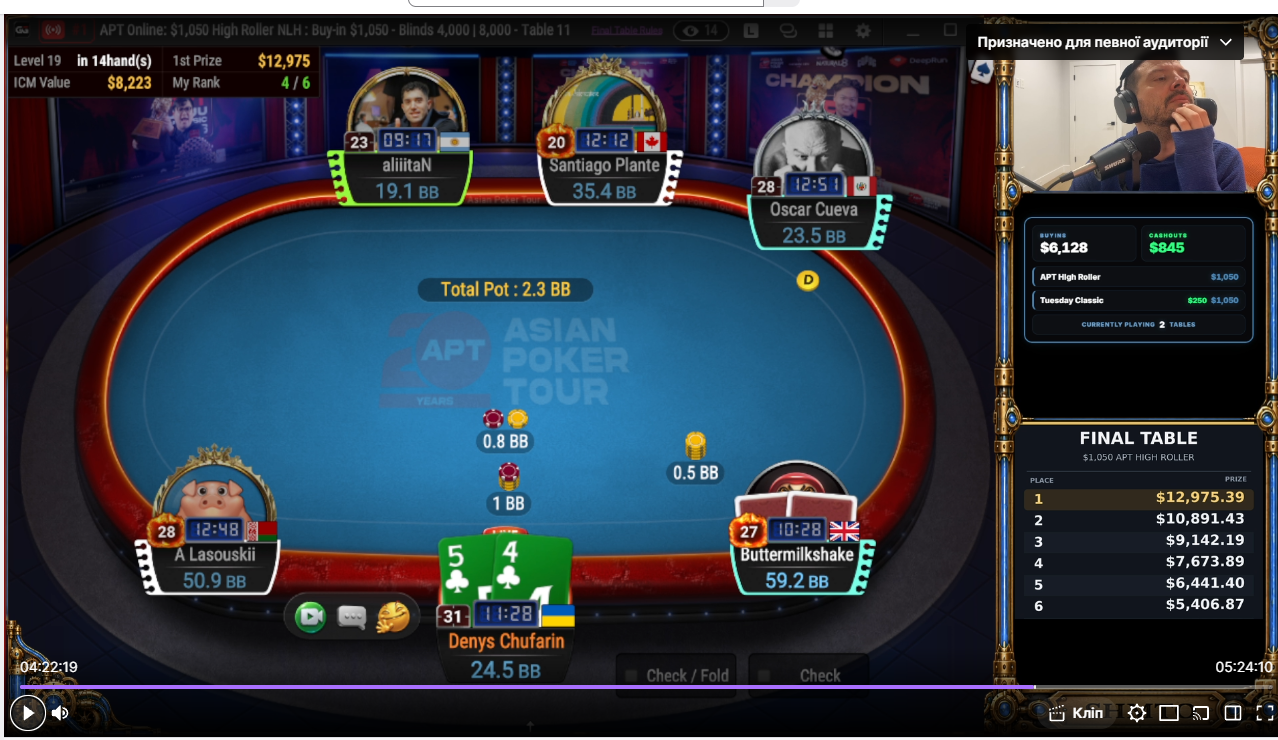
That matters. The chip leader can put pressure on me. Losing chips at this final table is more costly than it would be without significant ICM pressure. And this is not a complete unknown: I have already seen him playing actively.
So my starting expectation is that he will raise frequently.
The GTO Wizard screenshot shows a similar situation, not an exact reconstruction of this hand. The stacks are different. Its purpose is to illustrate the baseline: in that configuration, the small blind’s strategy is built almost entirely around raising, including shoving, with practically no limping.
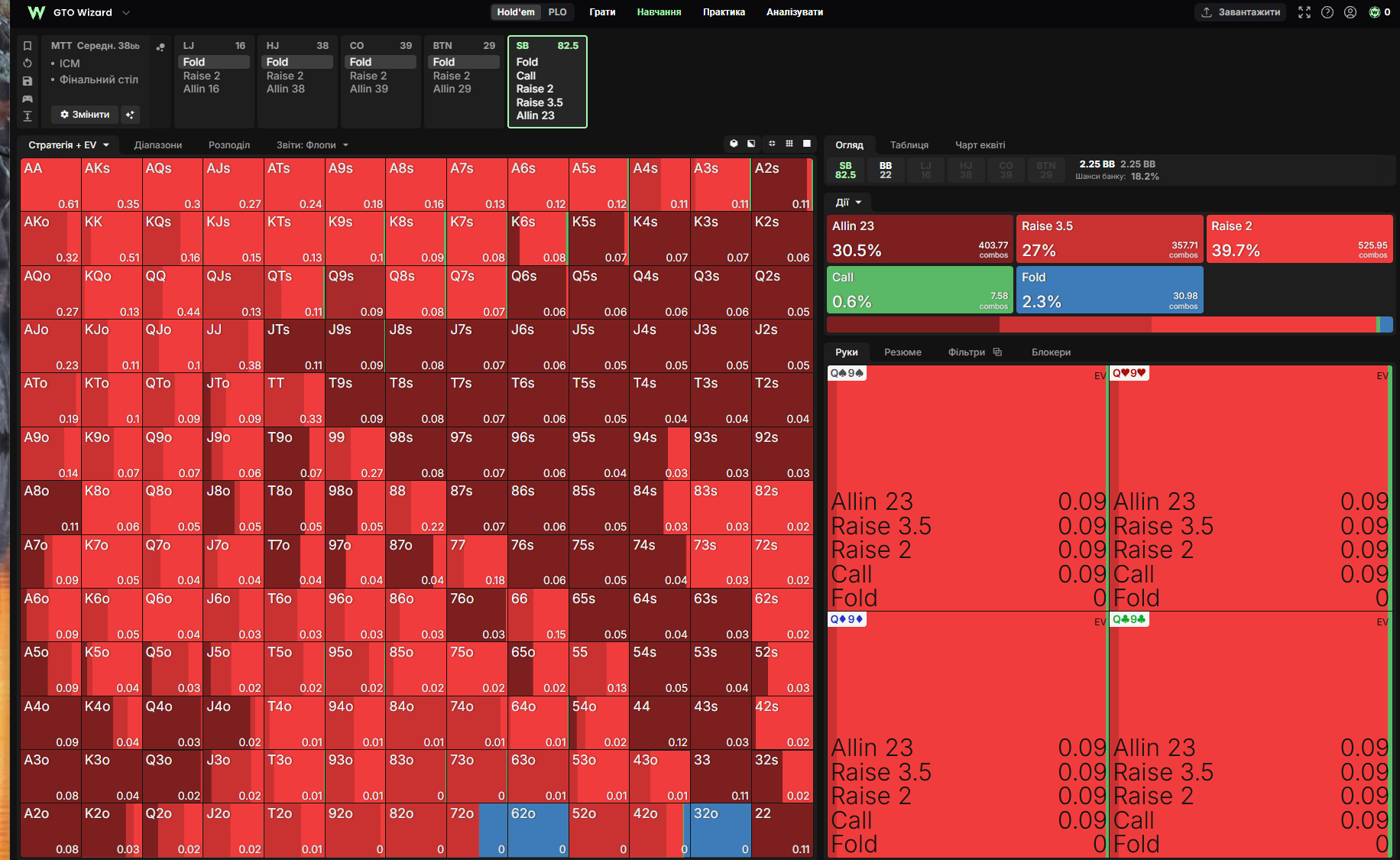
Different or more complicated configurations might produce a narrow limping range. The point is not that limping is forbidden at every final table. The point is that you need to understand the strategy created by the particular stack distribution. You cannot automatically carry familiar chip-EV limps into a spot with a very different distribution of ICM pressure.
And now the player I expect to be aggressive chooses to limp.
What has he kept in his limping range?
My first question is not “Which two cards does he have?” It is “Which hands did this person decide not to raise?”
An active player can understand perfectly well that raising is attractive here, yet still look down at 74 and think: “Okay, let’s just limp this one.” That is the human decision I am trying to identify.
My read is that he would usually raise his strong hands and most of his aces. His limps are more likely to include hands such as 87, 98, 74, 54, 43 or 53: hands with which he wants to see a flop without building the pot.
This is a hypothesis about a particular opponent, not a claim that nobody ever limps a trap.
That distinction matters. I am not deleting strong hands from his range with a magic button. I am giving them much less weight than I would without information about the player and the situation.
The flop: why bet when I do not expect folds?
The flop is Q♠6♣5♠. I have bottom pair with 5♣4♣. He checks, I bet 1.5 BB into roughly 2.8 BB, and he calls.
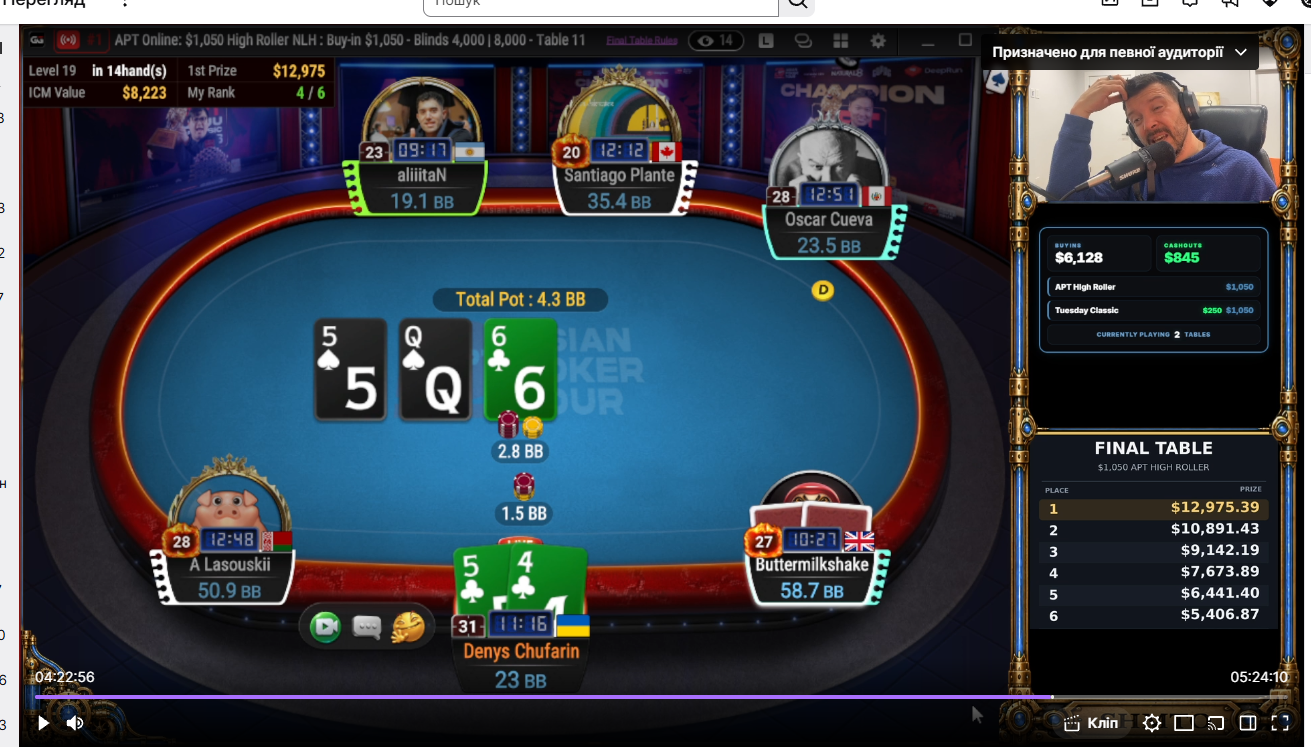
My bet is not based on an expectation that he will fold half his range. Quite the opposite: after this limp, I expect him to continue very often with draws, pieces of the board and hands that want to see another card.
An occasional offsuit T9 might fold. But most of the range I assign him is staying in.
“His range is weak” is not, by itself, proof that betting is profitable. What matters is which worse hands call, which better hands continue and how often we face a raise. In my reading of this spot, there are enough weak continues and little enough aggression to make me choose a bet.
I also give him relatively few queens. Something like Q2 or Q3 might have found its way into his limping range, but with a pair on this draw-heavy flop, I would often expect this particular player to lead or take a more aggressive line.
A check-call does not prove he has no queen or six. But within my model of this opponent, it shifts the range further towards weak made hands and draws.
The turn: telling a story you do not believe yourself
The turn is the A♥. He checks again, and I check back.
At first glance, the ace should scare me. But my preflop assumption was that this player raises most of his aces. So this card does not automatically mean: “He has top pair now.”
That does not mean I have to keep betting.
Yes, a second bet could deny some equity. But checking keeps his missed draws in the hand, avoids building a bigger pot with my weak pair and denies him the opportunity to put me in an uncomfortable spot with a check-raise. On an ace, he might decide it is a good moment to represent strength.
I have not ruled out every hand stronger than mine, either. An occasional A2, Q2 or another made hand could still be there. Calling his range weak does not mean that every single hand in it loses to 54.
There is also a psychological effect. My check may look to him like: “Yeah, bro, that ace is yours. I’m scared.”
I do not have to believe that story myself to understand how he might interpret it.
The river: why the big bet did not scare me
The river is the 6♥. He bets 7.9 BB into roughly 5.8 BB.
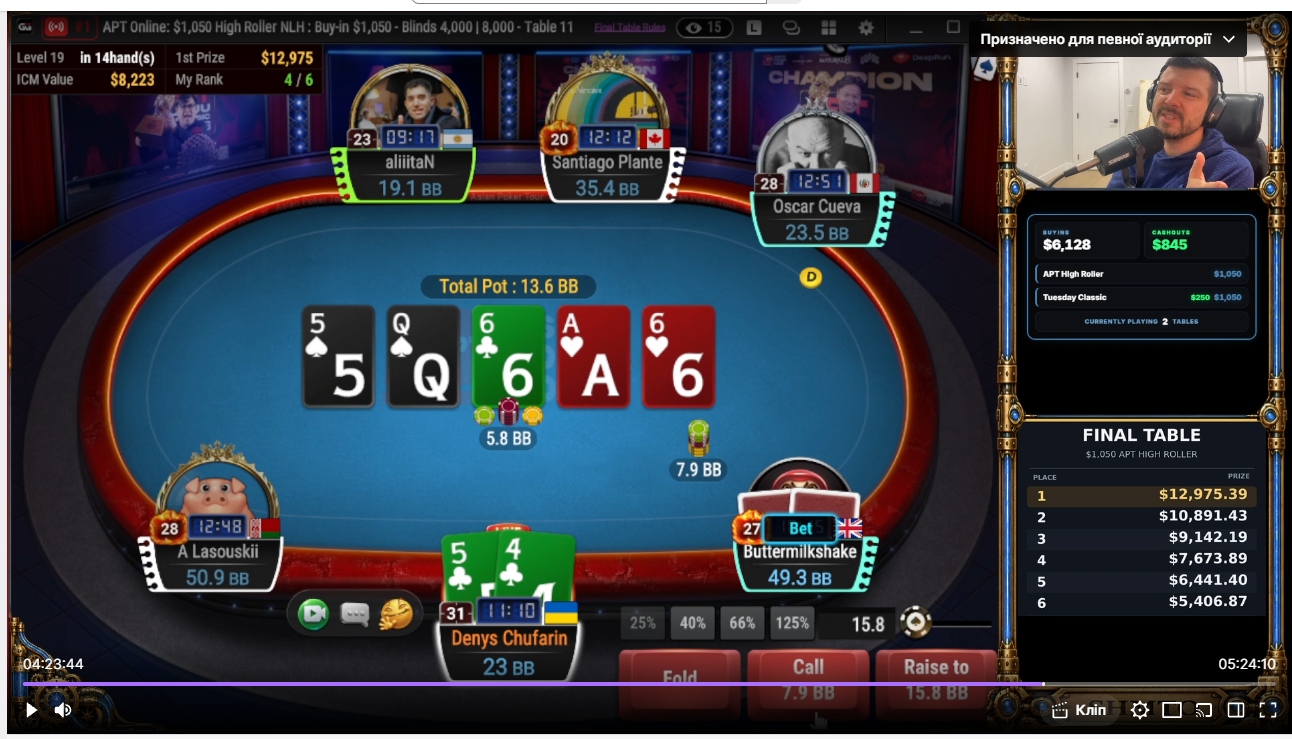
It is an overbet. And within my read, it makes me more interested in calling, not less.
With this size, he is primarily representing a very strong hand, such as 6x. An ordinary weak pair is a less convincing explanation. He is telling a polarized story: strong value or a bluff.
Now I go back through the earlier streets. How much strong value reaches this river by this exact route? Which sixes did he limp, check-call on the flop and check again on the turn? How well does that fit what I have already seen from him?
My assessment is that there are few such combinations. Meanwhile, plenty of draws have missed: the spades have not come in, and many of those low connected hands have not improved enough.
There is another possible human thought process: with a real six, this opponent might choose a smaller bet to get paid by my apparently weak range. But that is an additional read, not a rule that “nobody overbets trips.” A good player can absolutely use a big size for value.
My call rests on the whole sequence, not on one bet size.
How weak a hand could catch this bluff?
I was confident enough in this read that I would consider calling with some unpaired hands containing a king or even a jack. But that is an assessment of a specific imbalance, not universal advice to call overbets with any high card.
Even when an opponent bluffs frequently, you need to understand what those bluffs are. You can correctly identify a lack of strong value and still lose to a hand he has turned into a bluff. Some weak hands will also split the pot on this paired board.
And at a final table, ICM makes a mistake more expensive. “I think he’s bluffing” is not enough. You need strong reasons to believe he has too many bluffs.
In this hand, I believed I had those reasons, and I called.
What I want you to take from this hand
Do not start reading a range only when a big river bet appears in front of you.
Start asking questions preflop:
- What does this player normally do in this situation?
- Which hands would he usually play another way?
- What does his unusual decision suggest about the composition of his range?
Then test your hypothesis on every street. Do not force every new piece of information to fit it. If a card or an action puts enough value back into his range, you need to change your assessment.
Understanding optimal strategy is useful for more than copying it. It gives us a reference point: we notice a deviation, consider the human reason behind it and build a response.
That is why a confident river call can begin with a very simple preflop question: “Bro, what exactly are you limping here?”
I eventually won the tournament and played heads-up against this same opponent, Buttermilkshake. But winning the tournament does not prove that this call was good. What matters for this analysis is the reasoning we can explain before seeing the showdown.
Watch the hand on stream from 4:22:35: https://www.twitch.tv/videos/2912231309?t=04h22m35s