One board, four strategies: why raising does not oblige you to bet
The same Q♣ J♣ 6♣ monotone flop, four different situations and very different betting frequencies. Why ranges and position matter more than an automatic c-bet.
Initiative does not buy you the right to bet
It is easy to fall into a simple pattern: I raised, someone called, so now I should c-bet. Sometimes we add another one: I limped the small blind, the big blind checked, so I can bet and take it down. “Automatic profit,” as people like to call it.
Before clicking the button, though, let’s look at the hands we actually brought to the flop. And the hands our opponent brought with them.
I will use the same board throughout: Q♣ J♣ 6♣. Three cards of one suit. We start with 45 BB preflop. The situation changes, but the cards stay put. We will go from a range bet to a spot where I would simplify my strategy by checking my entire range.
Here is the point: our previous action does not, by itself, give us permission to do anything. Our flop decision depends on how two ranges interact with the board and with position.
One board in four situations
Below are four ChipEV solutions from GTO Wizard. I call the earliest position EP; the screenshots label it UTG. The frequencies belong to the specific solutions shown.
Notice the bet sizes, too: one-quarter pot in the first example, one-fifth pot in the next two, and half pot in the limped pot. The pots and available continuations also differ. This is not an experiment where we changed only position and measured its effect. These are four actual spots that make a useful comparison for understanding the logic.
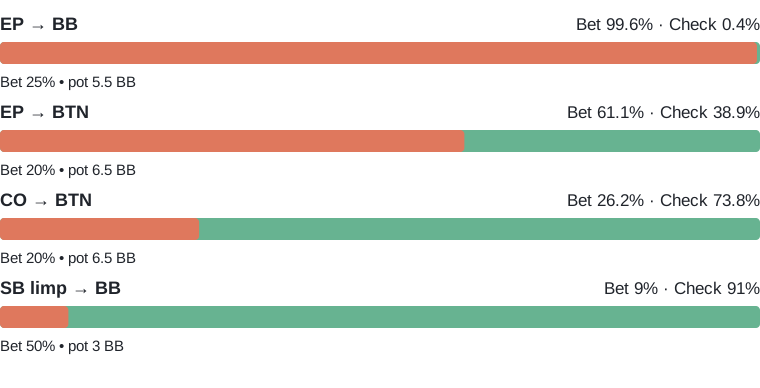
| Situation | Bet | Check | Bet size |
|---|---|---|---|
| EP / BB | 99.6% | 0.4% | 25% |
| EP / BTN | 61.1% | 38.9% | 20% |
| CO / BTN | 26.2% | 73.8% | 20% |
| SB / BB (limp) | 9% | 91% | 50% |
1. EP versus BB: bet the entire range
We open from early position, the big blind defends by calling, and then checks the flop. We are in position with a fairly narrow preflop range. The BB’s defending range is much wider.
On Q♣ J♣ 6♣, we range-bet: bet our entire range using a small size, one-quarter pot.
Why? We have a high concentration of strong hands, while the BB has not reached the flop with only hands that connect well. Their wide range contains plenty of hands that struggle to continue against pressure. If they call, we still have position and can decide how to proceed.
Of course, the BB also has flushes and other strong hands. We are not pretending their range is empty. We are looking at the whole collection of hands on both sides and how they play.
One more important point: range-betting does not mean that every bet has a huge EV advantage over checking. Frequency describes the chosen strategy. The size of the advantage of one action over another is a separate question.
The range bet here comes from the specific situation. “I was the raiser” does not explain it on its own.
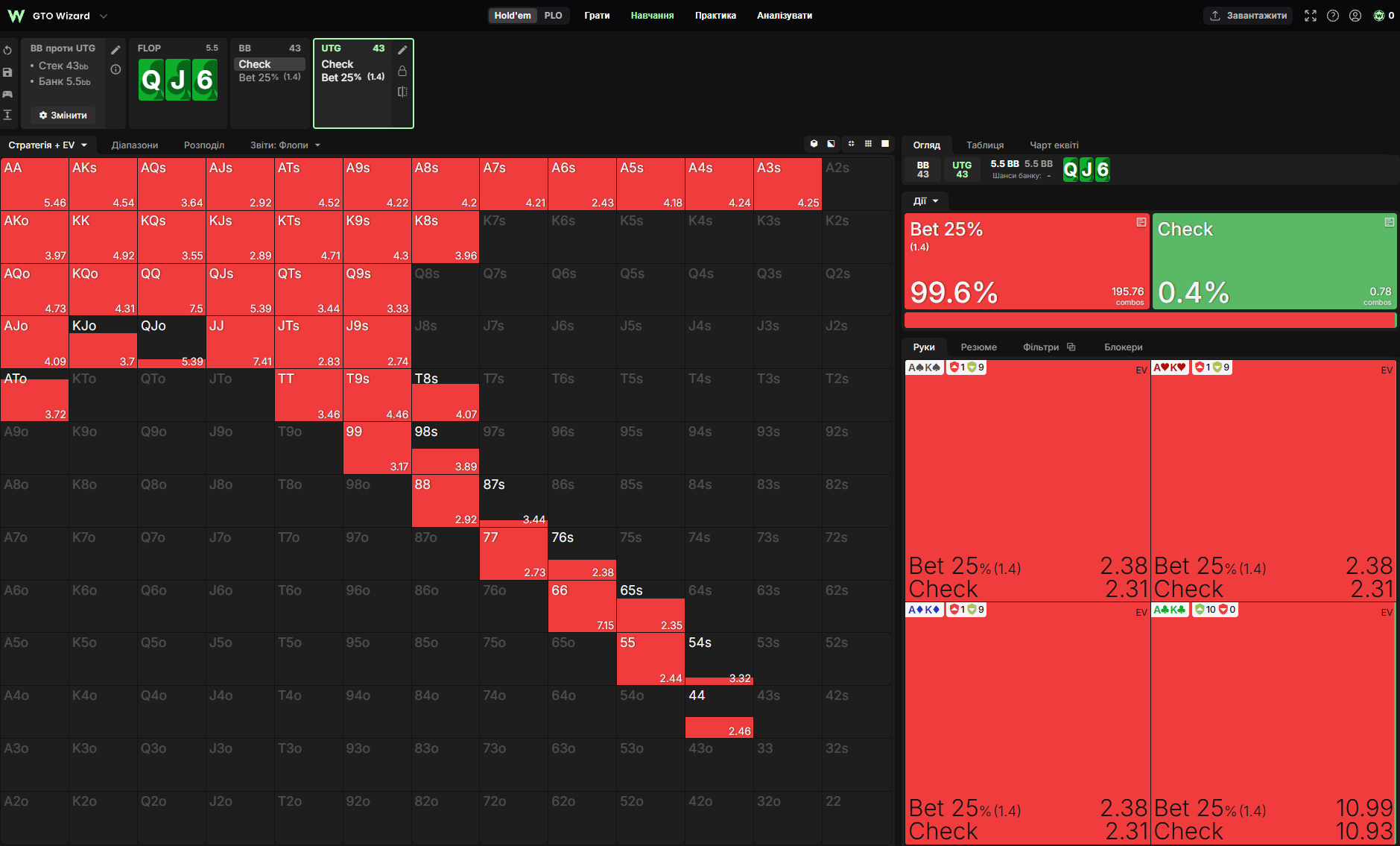
2. EP versus BTN: the strong range remains, but the situation changes
Now we open from the same early position, but the button calls. The board is unchanged. This time, betting occurs 61.1% of the time, with checks making up the remaining 38.9%.
What changed? A different range calls us on the button. Against an EP open, it is much tighter and stronger than the big blind’s calling range. We cannot simply transfer everything we knew about the BB’s wide call to this opponent.
We are also out of position now. After we bet, our opponent gets to respond knowing what we have done. If they call, that difference does not disappear on the turn or river.
Our range is still strong enough to bet frequently. But we no longer automatically bet every hand. Some hands prefer to continue by checking, and those checks include more than just hands we intend to give up.
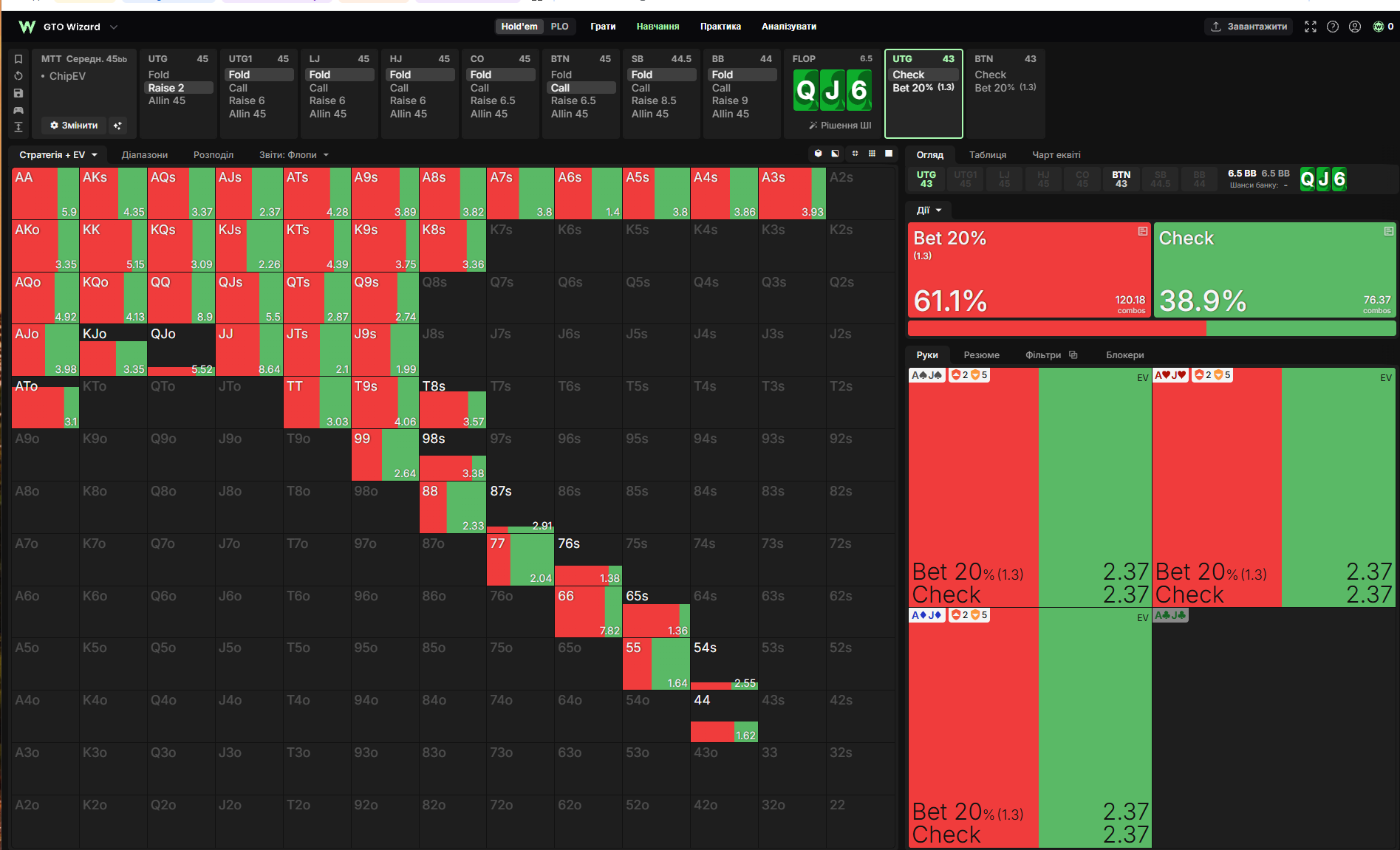
3. CO versus BTN: still the raiser, but checking much more
Now let’s open from the cutoff. The button calls again. On Q♣ J♣ 6♣, the betting frequency falls to 26.2%. Checking accounts for 73.8% of the strategy.
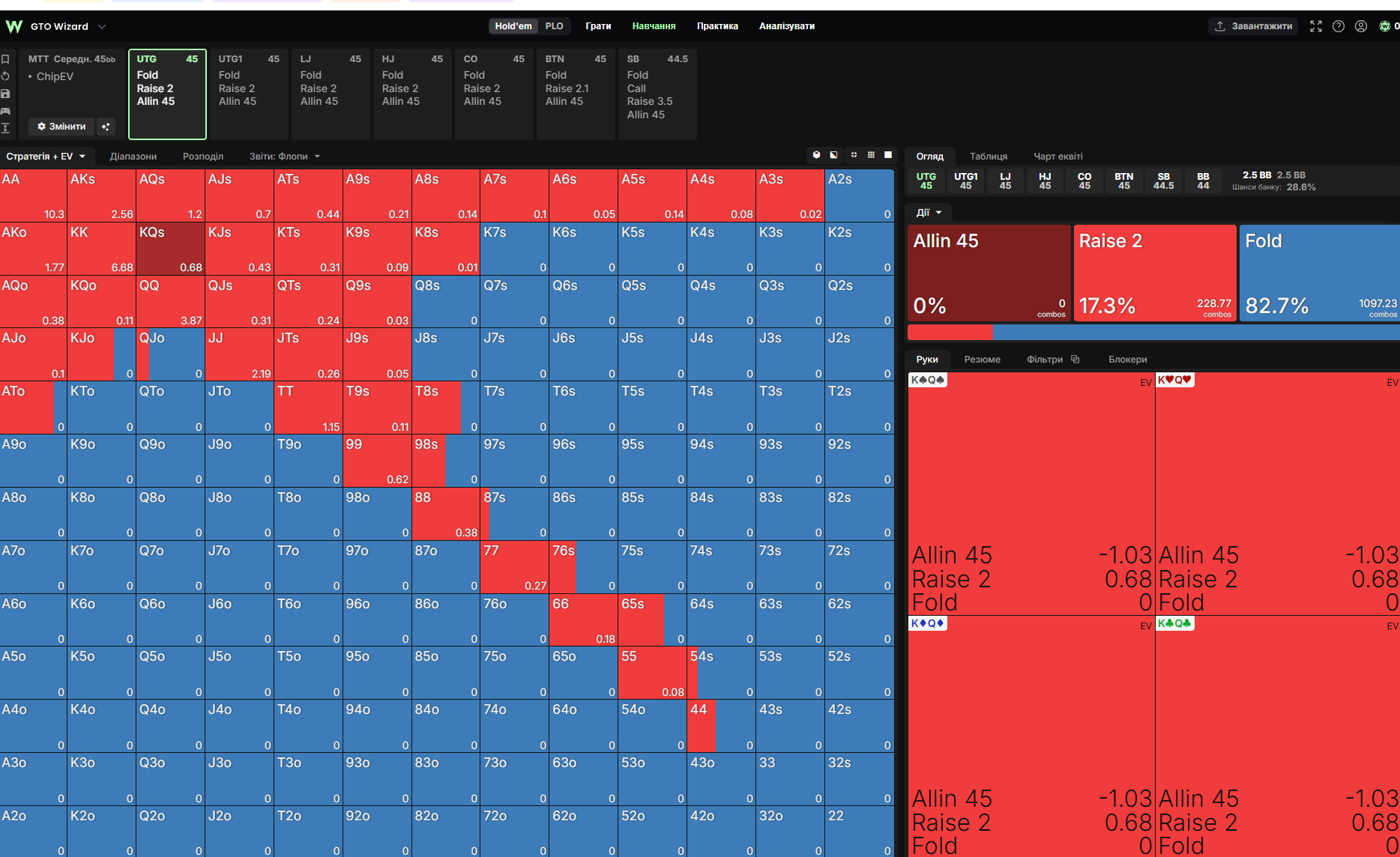
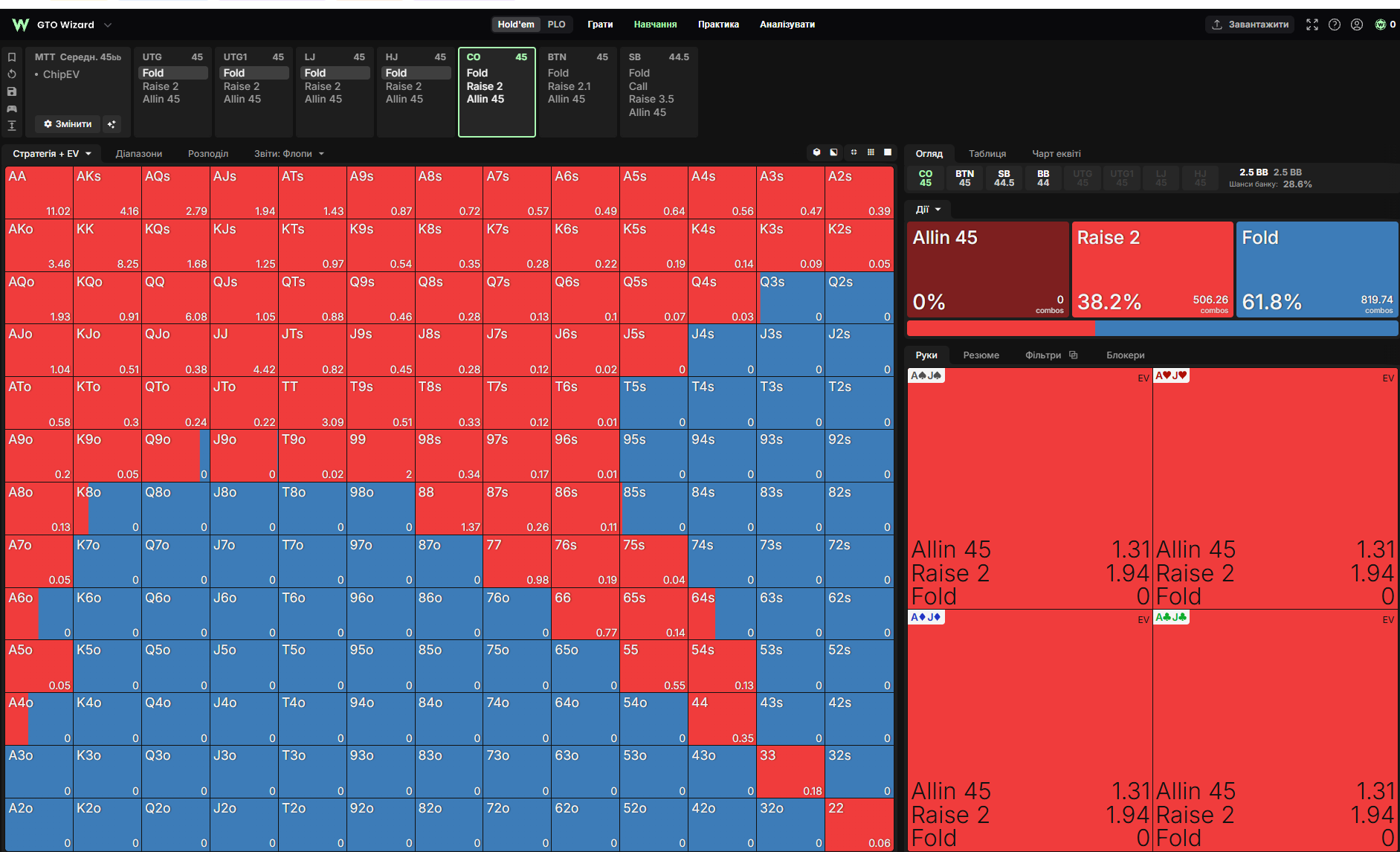
This shows why “we are out of position” is not a complete explanation. We were out of position in the previous example, too. But EP opened a narrower range, whereas CO started with far more hands: the preflop solutions shown open 17.3% and 38.2%, respectively.
As our opening range changes, so does the button’s response. A different relationship between the ranges reaches the flop. We cannot take all the extra hands we opened from CO and automatically bet them just because we were the preflop aggressor.
Checking becomes our main line. We retain the option to call, check-raise or fold, depending on our hand and our opponent’s actions. We do not have to be the first to build the pot with everything we brought to the flop.
That is the difference between memorising a button and understanding a situation. The preflop “raise” button was the same. The range behind it was different.
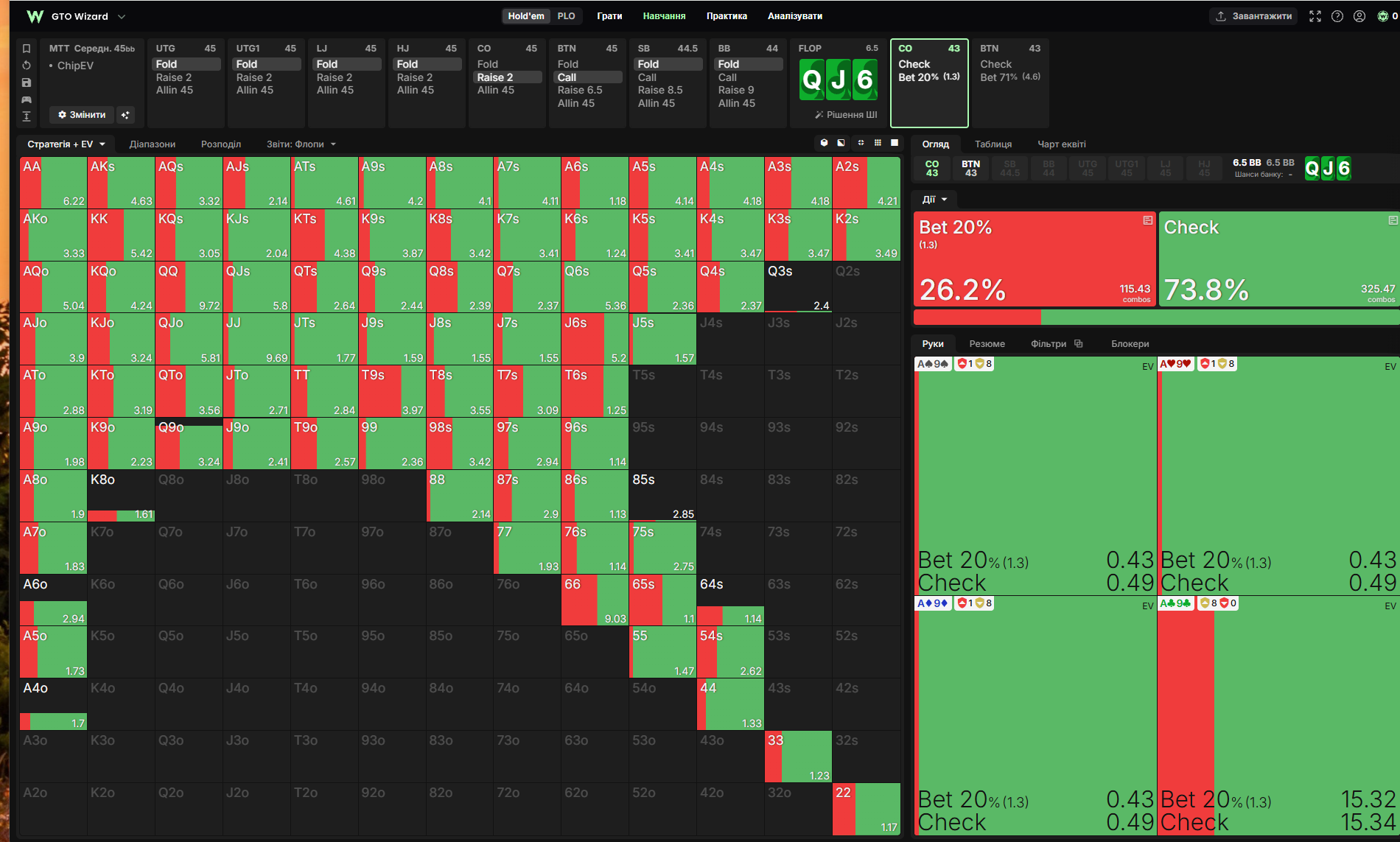
Compare the EP and CO preflop ranges
4. SB limps, BB checks: automatic profit will have to wait
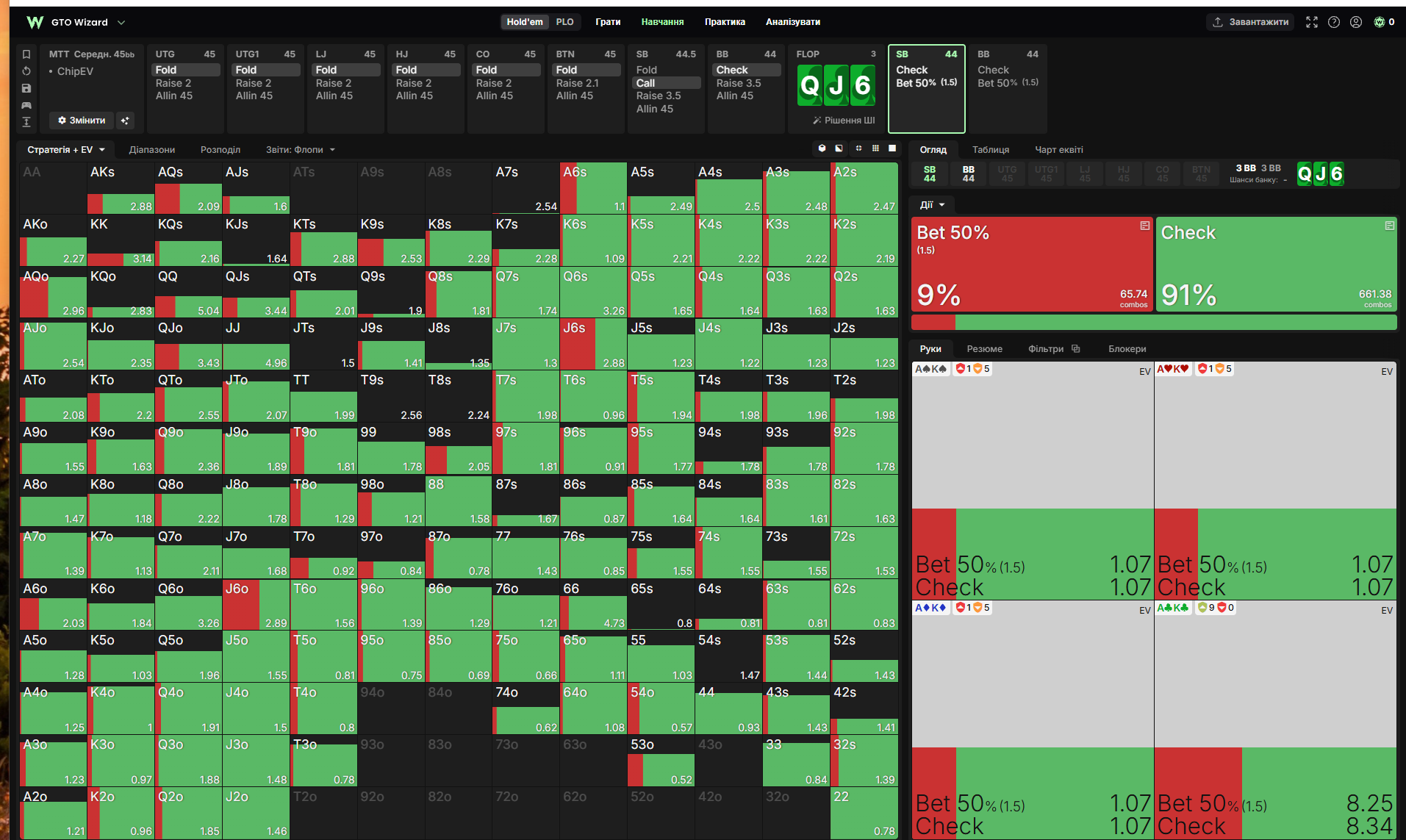
One final example. We limp from the small blind and the BB checks. The same Q♣ J♣ 6♣ arrives. Checking is so dominant here that, for a simple practical approach, I would choose to check my entire range. That is my simplification of the strategy: the original screenshot still shows a small betting component in the solver’s solution.
Technically, this is not a c-bet, because nobody raised preflop. But the habit is the same: “I started the hand, so now I bet.”
Yes, the BB raised some of their strong hands preflop. That does not make their remaining range an easy target for a bet with any two cards. Our own limping range is wide, too, and the BB still has position.
On a monotone board, it matters how many made flushes each player has, which cards of the suit they hold, and how well the rest of their hands can continue. The absence of a preflop raise answers none of those questions.
So “limp, then bet” can easily turn automatic profit into an automatic headache here. I would look at the ranges first.
Checking does not mean giving up the hand
I think one of the main problems is that we too often treat a check as surrender. As though we urgently need to preserve the initiative or the pot already belongs to someone else.
But checking can be a perfectly normal way to take a whole group of hands to the next street. That group includes strong hands, medium-strength hands and potential future bluffs. Our opponent does not get to bet with impunity just because we checked.
And the opponent at the table is not a solver. If they read our check as weakness, they may bet too often. Then the strong hands in our checking range pick up extra value, and check-raises become even more interesting. With bluffs, their next action matters too: if they bet too wide and then fold too much to a raise, we can exploit that.
This matters especially out of position. We act earlier and have less information. When we bet and get called, the pot grows, but position does not suddenly switch sides.
So the question before betting goes beyond “can I win the pot right now?” We need at least a rough idea of what remains in our opponent’s range after a call, how we will respond to a raise, and which turns we want to keep betting.
If we bet too many hands without that understanding, problems can accumulate. We may want to keep bluffing where the hands we need to fold are hard to push out. Or call a bet simply because we have already invested. A flop mistake can create the conditions for more mistakes later.
This is not a call to check 100% out of position on every board. We do not need to replace one autopilot with another. But getting comfortable with frequent checks is definitely useful.
What we actually need to understand about ranges
You do not have to hold every combination in your head to the nearest tenth of a percent. Start with simpler questions.
Which strong hands does each player have? On our board, that means flushes first, followed by other hands that can continue confidently. Which strong hands took a different preflop line, and which stayed in this one?
How many hands in each range connected poorly with the board? The BB’s wide range and the BTN’s more selective calling range are different things, even though both players clicked call.
Who has an easier time playing the next streets? Position provides information and more opportunities to realise a hand’s potential. But you cannot turn that into a universal rule of “subtract 40% of your bets when out of position.” The frequencies already differ substantially between two of our out-of-position examples.
Finally, what bet size are we discussing? A small bet with an entire range and a big bet with a narrow range serve different purposes. A useful guideline is that a wider betting range more often uses a small size, while a narrower, polarised range often bets bigger. But it is not a formula of “bet rarely, therefore bet big”: in our CO versus BTN example, betting is infrequent and the size is still small. We cannot compare only the percentages and forget what the solver is actually doing.
That is why I suggest studying preflop ranges. Not to build a collection of pretty charts, but to understand our starting point when we reach the flop.
We need logic we can take to the table
Poker does not require you to reproduce every cell of a solution from memory. But it can quickly punish confidence built on habit rather than understanding.
In these examples, remembering why CO checks so much against BTN is more useful than memorising 26.2%. On a similar board, you can at least ask the right questions instead of searching your memory for a matching picture.
Before your next automatic c-bet, try to picture both ranges. Not just your strong hands, but the weak part too. Not just your opponent’s weaknesses, but the hands they can fight back with.
Then ask yourself: why am I building the pot now, and how will I play after they respond?
Sometimes the answer will be a range bet. Sometimes it will be a very frequent check, which we may simplify to checking our entire range in our own game. The same board does not necessarily mean the same strategy.
Our job is to understand when our range allows us to apply pressure, and when it makes more sense to see what our opponent does first.