DENYS CHUFARIN · 23 OCTOBER 2026
Short Deck: fewer small cards, just as many big problems
Imagine playing poker, getting dealt seven-deuce again, folding and waiting for the next hand. Now imagine you are very wealthy, playing somewhere in Asia, and you have had enough of waiting.
The solution? Don't shorten the session. Shorten the deck.
The poker-table version of the Short Deck origin story goes something like this: “Let's throw these bloody small cards out and actually play.”
That's our humorous retelling, of course, not the minutes of a historic meeting. But the idea is close: leave more hands that people want to play. The result is a game where your two cards look familiar, but your usual assumptions about their strength suddenly stop working.
I played Short Deck for many years. And I want to explain why it is much more than Hold'em with part of the deck missing.
Where did the game come from?
According to the account on Paul Phua's website, Short Deck developed through experiments in Asian high-stakes cash games involving Phua and Richard Yong. They wanted a more engaging game: less time looking at hands that go straight into the muck, and more time playing pots.
Phil Ivey and Tom Dwan introduced the format to a wider audience in 2015. In 2018, Short Deck gained a major international stage at Triton in Montenegro, where Ivey and Jason Koon won events in the format.
This grew well beyond a home-game experiment. A serious game developed around the shorter deck, with its own strategies, expensive mistakes and players who understand exactly why your pretty cards are not as pretty as you think.
And this isn't just a story about expensive Asian games or Triton tournaments. Short Deck is one of GGPoker's cash-game formats, and I am a GGPoker ambassador. The game is alive online, not just in recordings of legendary hands.
What exactly did they remove?
Short Deck is also called 6+ Hold'em. All the twos, threes, fours and fives are removed. That leaves 36 cards: six through ace.
The rest looks familiar: two hole cards, a flop, a turn and a river. But removing 16 cards changes more than the amount of trash you get dealt. It changes the probabilities, the value of your hands and how often your opponent can make something strong.
Even pocket aces arrive roughly twice as often: once every 105 hands instead of once every 221 in regular Hold'em.
And, importantly, the game just doesn't let you get bored. You keep getting dealt something appealing: a pair, suited cards, connected cards. You look down and think, “Oh, I can play this.” Then again. And again. Instead of endlessly waiting for one good hand, you keep finding a reason to get involved.
Sounds great. Except you are not the only person getting pretty cards more often.
More aces also don't buy you the right to win pots comfortably. In the shorter deck, your opponents' hands much more often have a real chance to run you down.
Familiar hands, a different ranking
Before your first game, check the rules at that particular table. Not “I'll figure it out when I make a hand.” Ideally, before you proudly turn over a losing full house.
Here are the main differences:
- A flush beats a full house. Only nine cards of each suit remain, so making a flush is harder than you are used to.
- The ace can play low: A–6–7–8–9 is the lowest straight. Think of the ace taking the five's place.
- There are different versions of the straight-versus-trips ranking. In GGPoker's format and the common Triton format, a straight beats three of a kind. In another version, the order is reversed.
There is no need to declare one version “correct” and the other a mistake. They use different rules, and those rules require different decisions.
Don't automatically import Hold'em's blind structure either. Short Deck commonly has everyone post an ante, with the button posting an additional compulsory bet. The starting pot and the price of entering a hand are organised differently.
Why your usual intuition breaks
In Hold'em, you gradually get used to certain relationships between hands: this one is far ahead, that one has a draw, and this one is almost dead.
In Short Deck, that internal table needs rebuilding.
With fewer cards, the cards you need make up a larger share of the deck. But the same applies to your opponent. You make strong hands more often. So do they.
If you hold a pocket pair, roughly 17% of flops will contain at least one more card of that rank. In regular Hold'em, it is about 12%.
A set is still nice. It just isn't rare enough to stop the music every time one turns up.
And the strength of your made hand right now is not the same thing as its chance of winning by the river. This is where it gets interesting.
Three preflop comparisons to reset your expectations
Here are specific hands and their equities before any community cards are dealt. These calculations use the version where a straight beats trips and a flush beats a full house:
| Hands | First hand's equity | Second hand's equity |
|---|---|---|
| 6♣ 6♦ vs J♥ T♥ | 31.7% | 68.3% |
| T♥ 9♥ vs A♣ A♦ | 39.7% | 60.3% |
| J♣ T♦ vs A♥ K♠ | 48.3% | 51.7% |
Sixes against JTs is nothing like the familiar “roughly a flip.” Suited jack-ten has more than two-thirds of the equity here. We already have a pair and they apparently have nothing. That “nothing” happens to do very well in a short deck.
Suited T9 has almost 40% against aces. The aces are still favourites, but their opponent is far from hopeless.
And offsuit JT against offsuit AK is almost even. Ace-king sounds more impressive, but the difference in equity here is small.
The point isn't that every matchup suddenly becomes 50–50. Just look at those sixes. The point is that your familiar sense of hand strength can let you down. You need to rebuild it for this deck.
A set against a made straight: who's actually ahead?
Take this specific hand in the version where a straight beats trips:
Our hand: 9♣ 9♦
Opponent: J♣ T♦
Flop: 9♥ 8♠ 7♦
We have a set. Our opponent already has a straight. By the current hand rankings, they are winning.
But if we get all the chips in on this flop and enumerate every possible turn and river, our share of the pot, including ties, is approximately 51.6%.
Yes. In this hand, the set is a slight favourite against the made straight.
Not because a set suddenly ranks higher. If the board doesn't help us, the straight wins. But in the shorter deck, there is a substantial chance that the next two cards turn our set into a full house or quads. Some runouts also split the pot.
That's why “they've already made it and I'm still drawing” isn't enough here. Look at the actual cards and calculate equity: your expected share of the pot, not the strength of your opponent's facial expression.
This number belongs to this particular hand. Change the flop, the hole cards or add another player, and the answer changes.
More good cards doesn't mean easier decisions
The biggest Short Deck trap is thinking you can now play everything. There are no deuces, so there must be no bad hands. Logical? Appealing. Wrong.
A hand can look great and still play awkwardly against your opponent's range. Suited cards don't guarantee a flush. Connected cards don't guarantee the highest straight. A strong pair doesn't guarantee you'll enjoy the river.
In a multiway pot, “I'm doing reasonably well against that player” isn't enough either. You must account for everyone. The hands remove cards that others need, and your share of the pot is calculated against several opponents at once.
This game makes you think again about familiar things. Instead of just looking at the name of your hand, you need to understand what is really happening to its chances.
My Short Deck experience
There was a period when I played only Short Deck. So, for me, it is more than an interesting poker variant with a few fun facts attached.
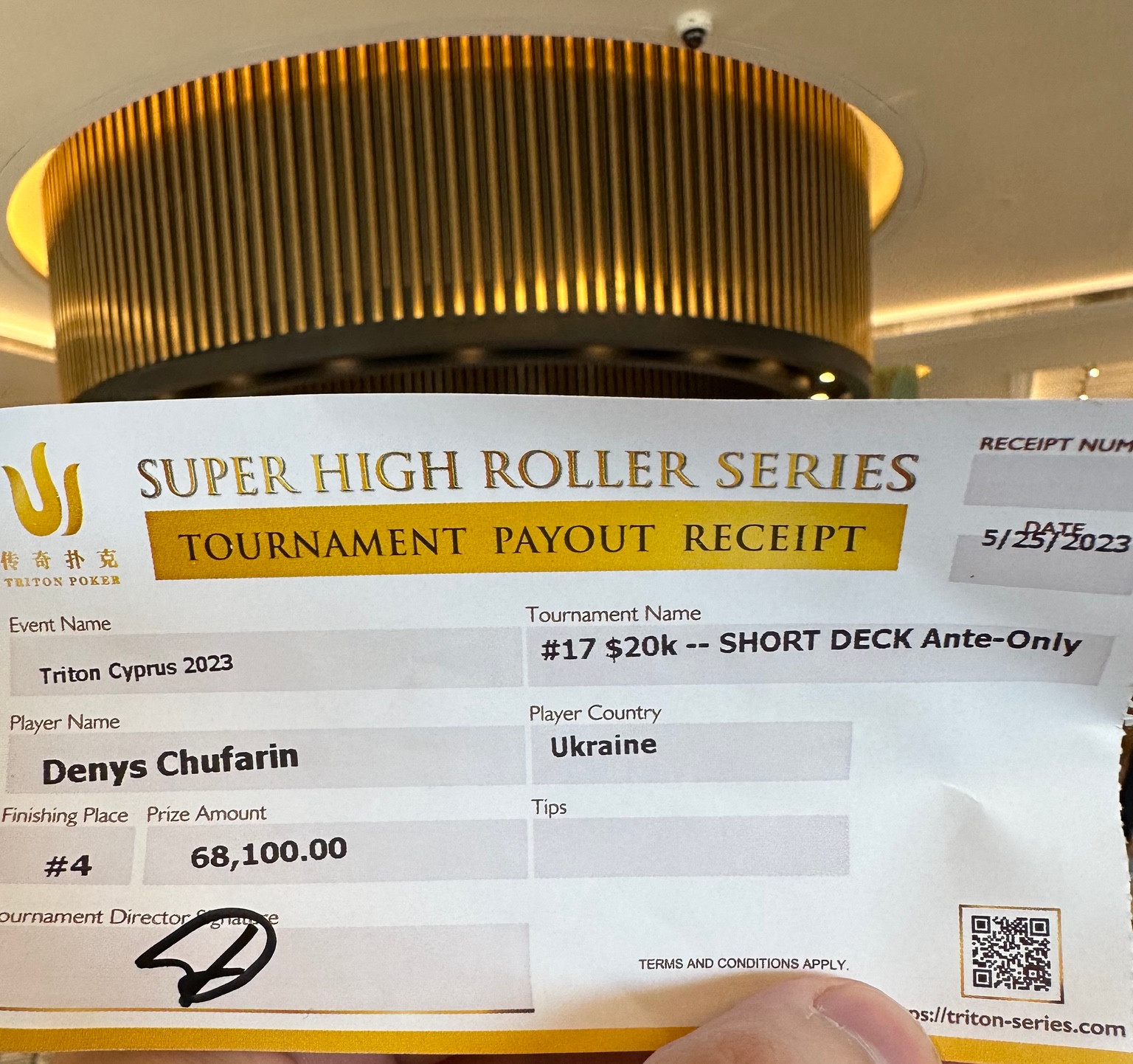
My first and, so far, only Triton cash in Short Deck was fourth place in the $20k Short Deck Ante-Only event at Triton Cyprus 2023, for $68,100. So this story has a very concrete personal chapter, too.
Here is a video of my Short Deck final table at Triton from that period. A little personal history alongside the theory:
Triton final table
I REACHED THE FINAL TABLE ON TRITON SERIES
The YouTube player loads only after you click. YouTube will receive visit data.
Watch on YouTube ↗Short Deck in action
If you want to feel the pace of the game as well as read about it, here is “Мистецтво шортдек” — “The Art of Short Deck.” A dynamic gameplay montage set to music: fewer explanations, more of what happens at the tables.
Video in Ukrainian.
Video in Ukrainian
The Art of Short Deck
The YouTube player loads only after you click. YouTube will receive visit data.
Watch on YouTube ↗Where to start
I wouldn't start by rushing to get all-in and test whether “everything gets cracked here.” First, learn the rules of the version you are playing. Then look at preflop and a few simple equity comparisons.
Take two hands. Try to guess their chances. Add a flop and check how much your answer changes. Then add a third player. That is much more useful than simply memorising that Short Deck is “a high-variance game.”
I have an older English-language video called “PREFLOP 50 ANTE | ShortDeck strategy #1.” If this introduction makes you want to explore preflop strategy, it can be your next step:
Video in English
PREFLOP 50 ANTE | ShortDeck strategy #1
The YouTube player loads only after you click. YouTube will receive visit data.
Watch on YouTube ↗For these comparisons, use the 6+ equity calculator on this page: enter specific hands, add several players, and set a flop or turn. No need to take my word for it when I say a set can sometimes be the favourite against a straight.
Short Deck teaches one thing particularly well: a familiar picture doesn't necessarily mean a familiar answer.
They shortened the deck. You still have to think.
Sources and calculation checks
- Paul Phua: Short Deck's history and features.
- GGPoker: an introduction to Short Deck, its rules and hand rankings.
- GGPoker: the 6+ Short Deck format.
The probabilities of being dealt aces and improving a pocket pair on the flop were calculated combinatorially; the latter includes the rare case of flopping quads. Each preflop comparison was checked by exhaustively enumerating all 201,376 possible boards for the stated suits; equity includes each hand's share of tied pots. The set-versus-straight example was checked across all 406 turn–river combinations: 205 wins for the set, 192 losses and nine ties.