Why we can open wider on the button, why the blinds need so many 3-bets, and how to understand ranges instead of memorizing a colored chart.
People regularly ask me on stream: how do I improve? Do I need GTO Wizard? Holdem Resources Calculator? A coach? Another magical subscription that will finally stop the river ace from landing for my opponent?
I don’t know where you are in your poker journey. Maybe you play freerolls. Maybe $50 tournaments. Or maybe you’ve played $300 tournaments for fifteen years and still occasionally look at a preflop spot and think: “What is actually going on here?”
But there is one place I would start in almost any case: understanding the logic of preflop. Especially play from the blinds.
I started seriously studying tournament poker a little under two years ago. I had experience in various cash games, but no illusion that it would automatically solve every tournament problem. Whenever I learn a new game, my first stop is preflop. And in tournaments it keeps changing: stacks, effective stacks, sizings, payout pressure.
You cannot memorize all of it. And you don’t need to.
You need to understand why one hand is still playable, another is not, and a third suddenly wants to 3-bet. Access to good solutions helps. But the starting point should not be a collection of subscriptions. It should be a specific question you want to answer.
Today’s question is this: why do we often miss opportunities both on the button and in the blinds—and why does the same problem with 3-betting explain both?
About the examples. These are specific GTO Wizard MTT ChipEV solutions, mostly at an effective stack of 45 BB. They are not universal charts for every tournament: ICM, antes, sizings and other stack depths can change the decisions. The percentages refer to the particular situations shown, not someone’s overall HUD 3-bet statistic.
1. You Don’t Need to Win Every Hand in the Big Blind
In the big blind, we have to enter pots very often—with a huge range of hands. Our job is not to win every hand. It is to play those hands at least a little better than simply folding.
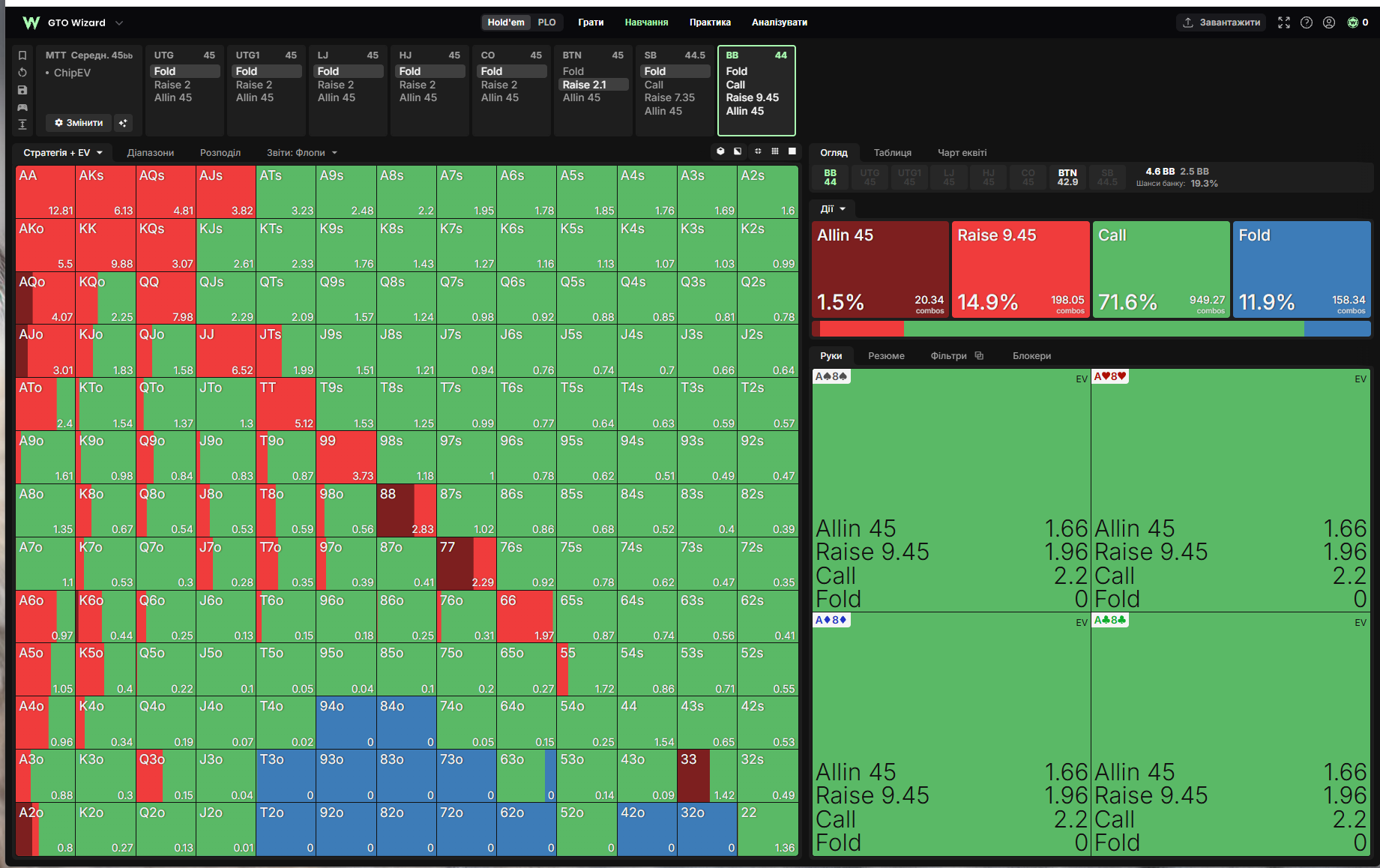
In our example, BTN opens to 2.1 BB and SB folds. BB only needs to add 1.1 BB. That price allows a much wider defense than intuition might suggest: roughly 72% calls and another 16% in different forms of 3-betting.
But a good price is not permission to call anything. You still have to realize your equity after the flop, out of position. That is where the real work begins.
2. Why 53s Can Be More Interesting Than a King
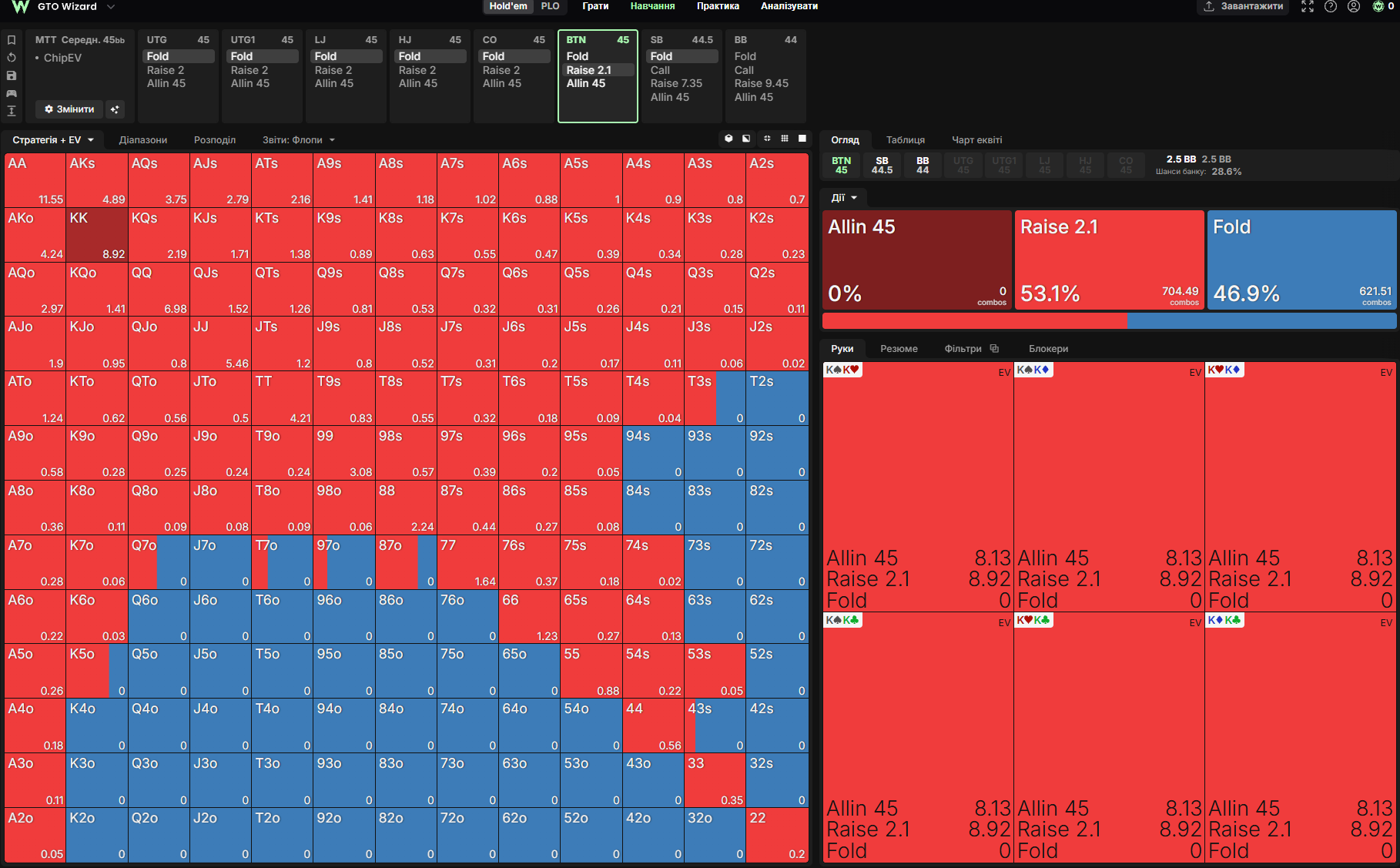
Now let’s look at the button’s opening range at 45 BB.
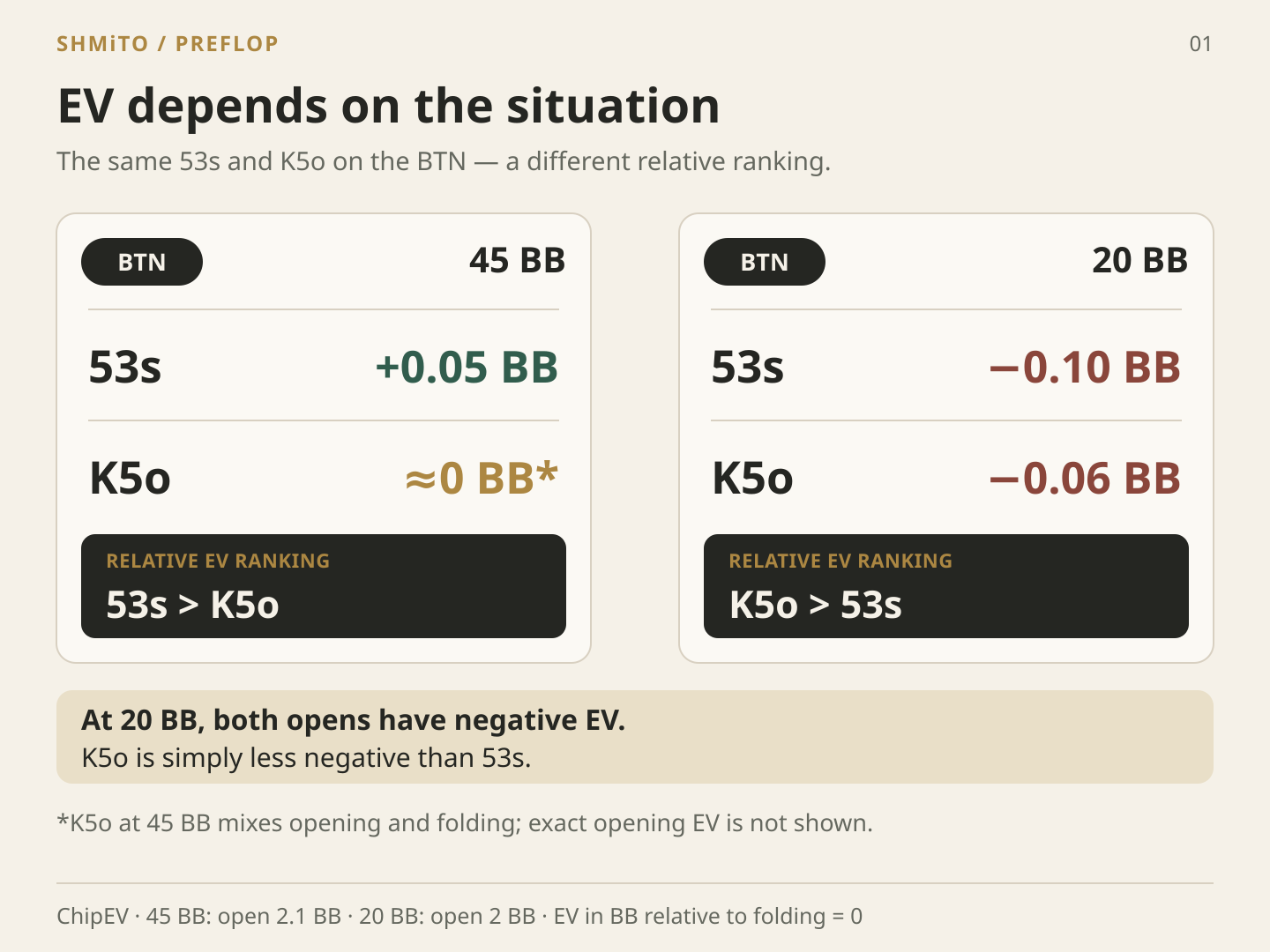
Compare two hands: 53s and K5o. At 45 BB, opening 53s has an EV of +0.05 BB, while K5o sits on the boundary between opening and folding—approximately breakeven. Here, five-three looks more attractive than king-five.
Why? Because a hand’s strength is not just its highest card.
Depth gives suited, connected hands more room: draws, strong made hands, opportunities to win additional chips on later streets. Position makes that potential easier to realize.
Now take the same 53s and K5o, but at 20 BB. Opening 53s now has an EV of −0.10 BB, while K5o has −0.06 BB. Their relative order has changed: king-five now looks better than suited five-three. Both hands should fold here, but the main point is how their value relative to each other changes as stacks get shorter.
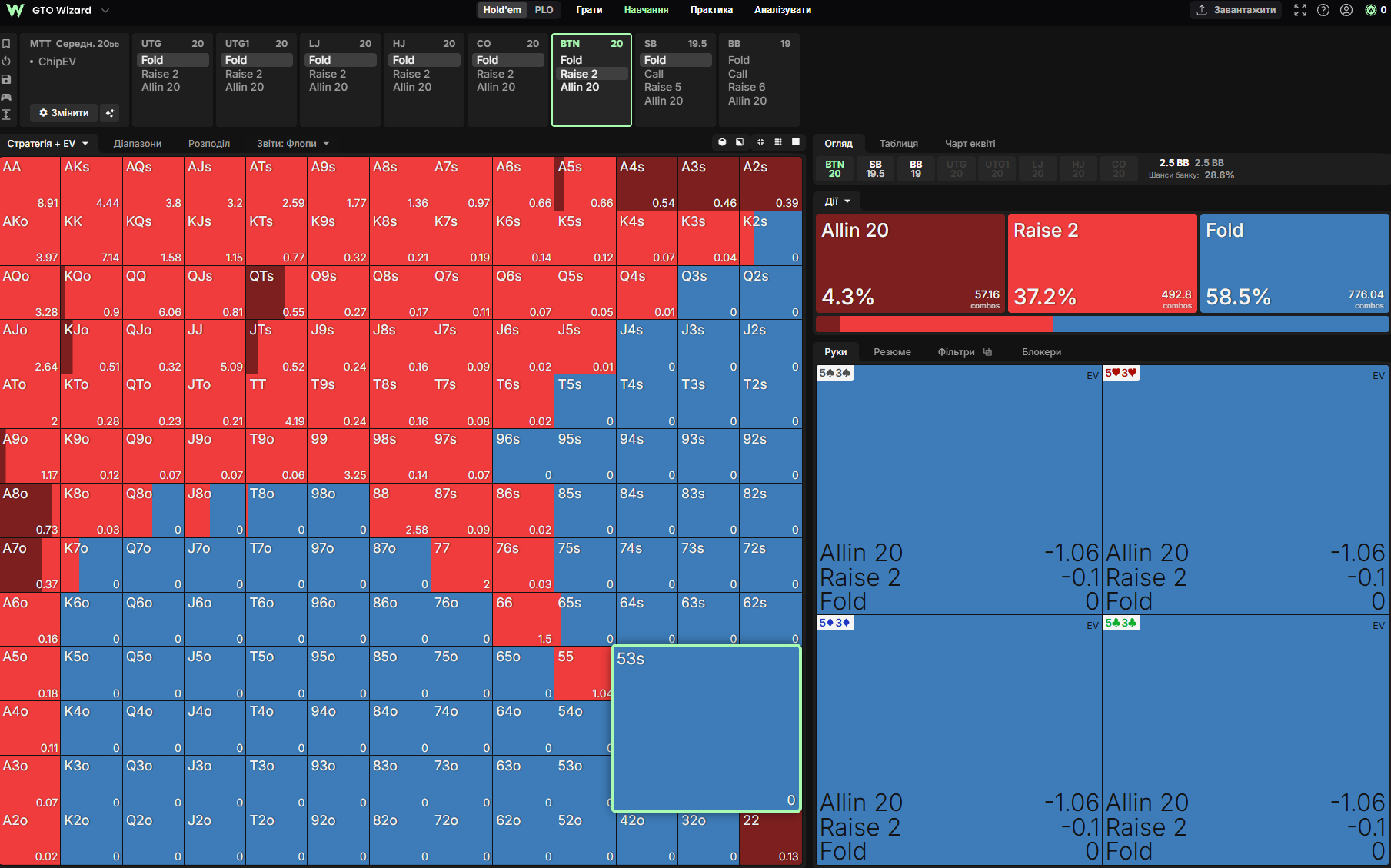
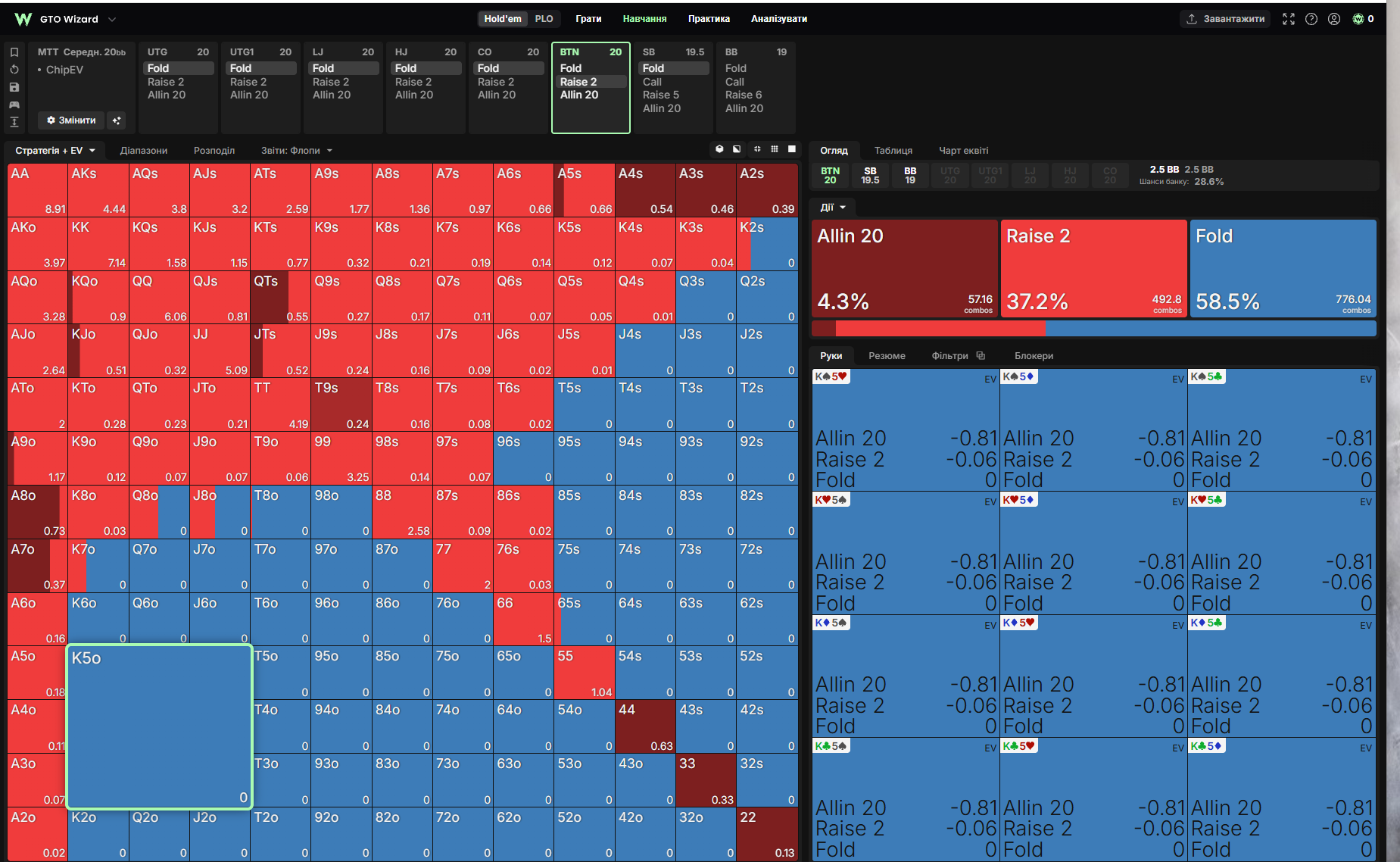
The general logic is simple: at shorter stacks, high cards, blockers and the strength of your pair and kicker become relatively more important. With K5 on a five, your kicker is better than with 53. And with fewer chips behind, decisions involving one pair come up more often.
That does not mean flush draws have been canceled at 20 BB. The relative value of a hand’s different properties has simply changed.
Don’t memorize “53s is good” or “K5o is bad.” Understand where that hand’s EV comes from at that stack depth.
3. The Solver Is Not Opening Against Your Neighbor
Here is the main thing to remember when looking at the bottom of an opening range: the solver evaluates it against the corresponding strategies of its opponents.
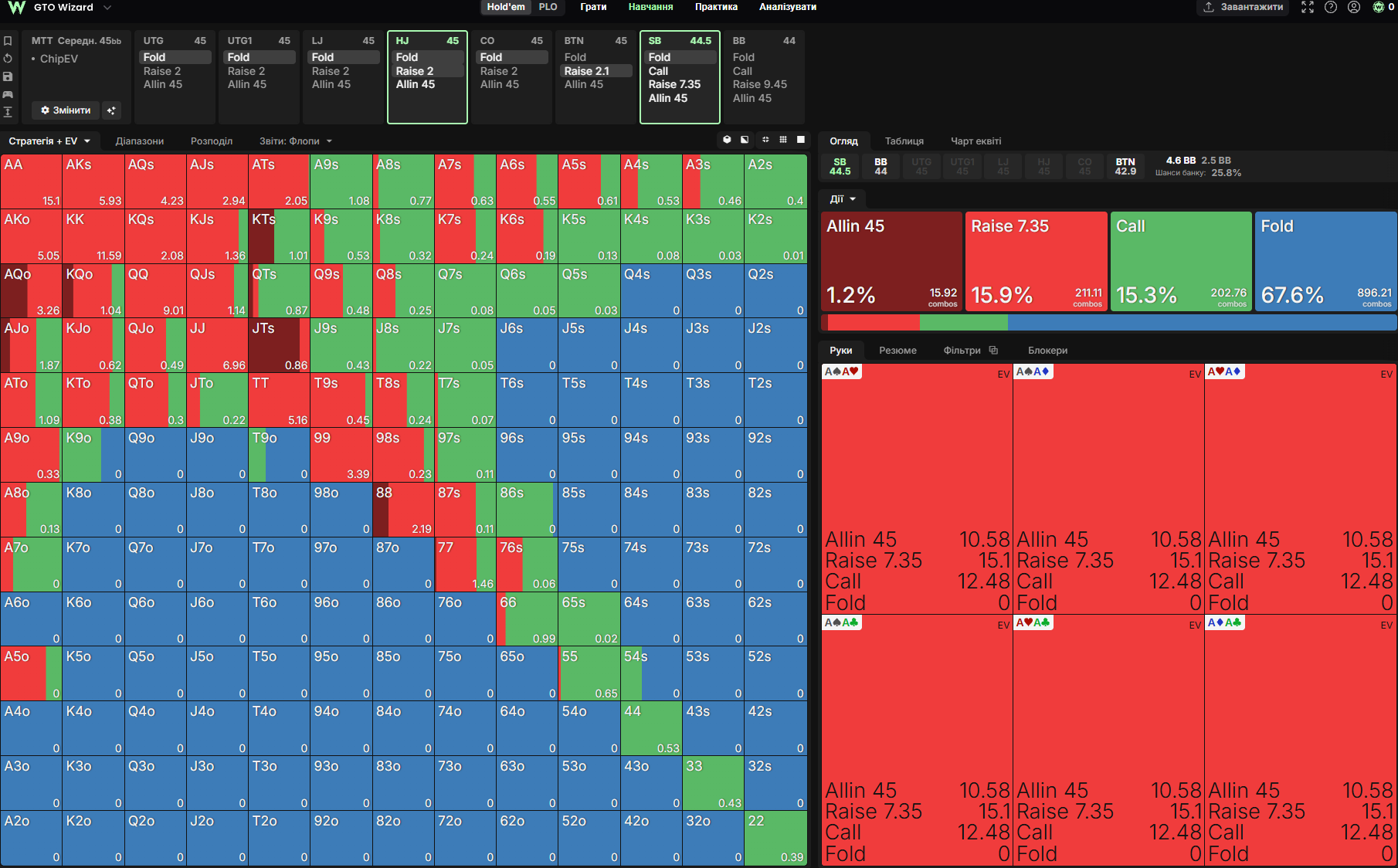
In our example, SB makes a non-all-in 3-bet against BTN roughly 16% of the time. BB, after SB folds, does so roughly 15% of the time. Both also have shoves.
Do all your opponents play that way? In my experience, far from it. But you need to look at the actual players, not declare an entire stake passive.
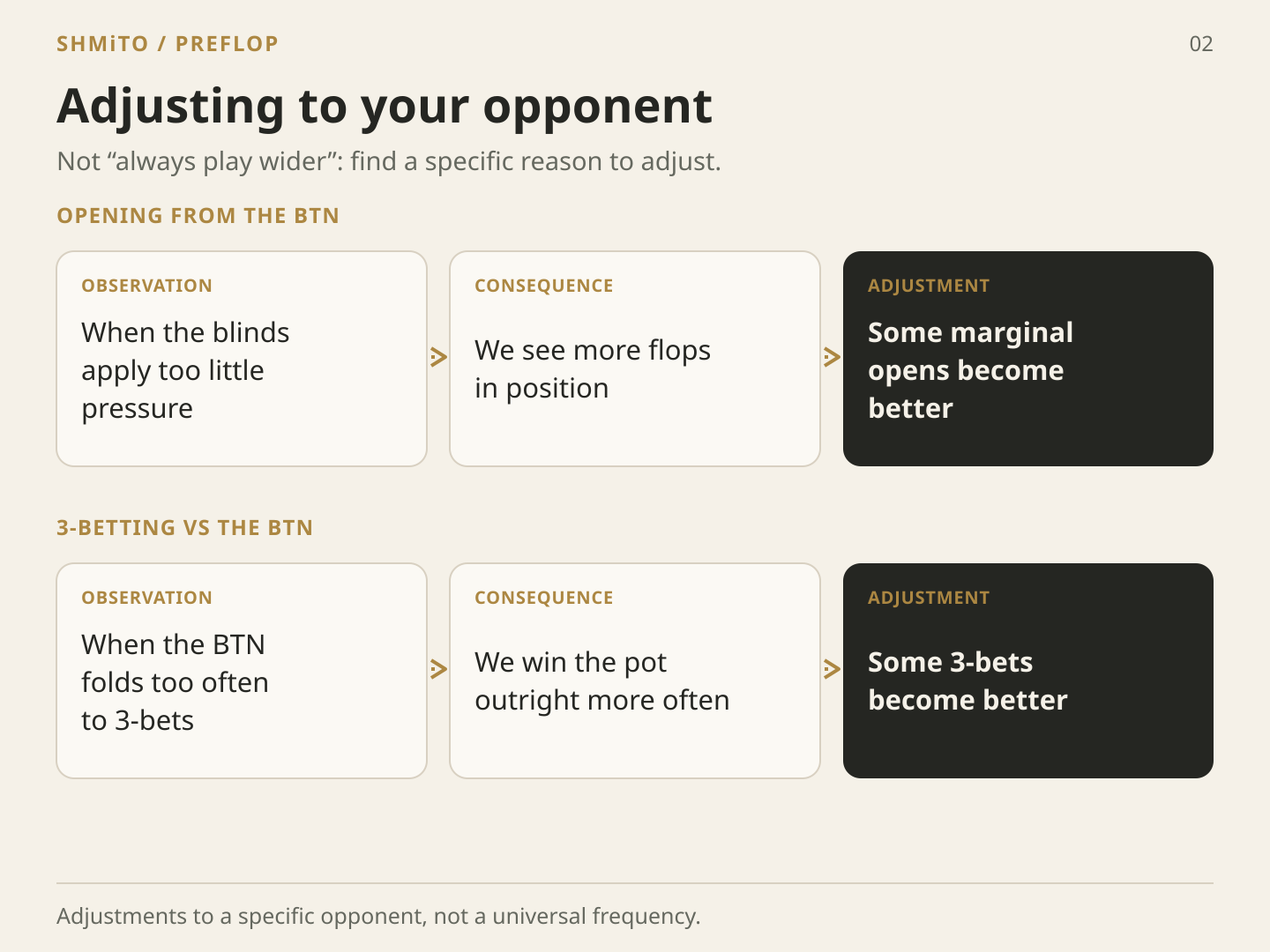
If the blinds don’t 3-bet enough, give up the pot more often, or let you see flops cheaply in position, some marginal opens can improve. A hand that would often be forced to fold preflop gets more opportunities to realize its equity.
We can open wider not because we feel brave today, but because our opponents are not charging us enough for opening.
One important point: a low 3-bet frequency alone does not mean “open everything.” Look at what replaces those 3-bets. Too many folds? Passive calls? Or calls followed by strong postflop play? Those are different situations.
4. Now Move Into the Blinds
If we understand why passive blinds make the button’s life easier, an uncomfortable question follows: are we giving the button that same freedom?
You pick up a hand suitable for a 3-bet and think: “Why build a big pot? I’ll just see a flop.”
Seeing a flop is not a free option in terms of the decisions that follow. You remain out of position, with a wide range and equity you need to protect. You need to check-raise at the right times, find bluffs and withstand pressure. If you don’t, a theoretically good call can become considerably worse in your hands.
A 3-bet is not a magic button either. But it offers something a call does not: the chance to win the pot immediately by folding out hands that still had equity against us.
And if the opponent folds extra hands that should continue, that part of the 3-bet’s value increases. Sometimes the choice between an almost equal call and 3-bet becomes much easier.
That is not a reason to 3-bet any two cards. It is a reason to stop passing up good aggressive decisions just because calling feels more comfortable.
5. Why A6o Can Want to 3-Bet While A6s Wants to Call
Look carefully at the weaker aces in BB’s range. We are talking specifically about A6o, A5o and A4o—offsuit hands. In the solution shown, they mix calls with non-all-in 3-bets. A6s, A5s and A4s stay in the calling range.
That is not random, and it does not mean an offsuit ace suddenly became stronger than a suited ace. We are comparing not just hand strength, but how valuable calling is for each hand.
A suited ace has extra postflop possibilities: flushes, flush draws, backdoors. There is potential to realize, and calling preserves it. If we 3-bet instead and then have to fold to a shove, we never get to see any of those possibilities. That is one reason not to automatically turn an attractive suited hand into a 3-bet bluff.
Calling with the offsuit ace is less attractive. But it retains useful properties for aggression: it blocks some strong hands and can fold out higher aces that dominate us.
For example, in the button’s response shown here, A8o, A7o and the lower offsuit aces fold. With A6o, we can fold out A8o or A7o and escape their domination. If the opponent continues with K6s, our ace gives us the better kicker when we both pair the six. Similar logic applies to other low cards: we fold out some hands that are uncomfortable to face and keep some calls against which we have useful advantages.
That does not mean A6o dominates the entire calling range. Nor does every higher ace fold: A9o mostly calls in this solution. If a particular player folds that too, it is an additional deviation by that player, not what the chart shows.
Counting combinations matters here. An offsuit hand has 12 combinations; a suited hand has 4, before accounting for known cards and mixed frequencies. A few offsuit hands can therefore make up a significant part of the bluffing 3-bet range. If you only look at the pretty suited cells, you may miss where the aggression actually comes from.
Don’t turn this into “never 3-bet suited aces.” We are examining a particular range. The important idea is: when choosing a 3-bet bluff, consider not only its potential but also the good call you may be giving up.
6. “What If They Call My 3-Bet?”
Then we play poker. Bad news: even after getting preflop right, sometimes you will still have decisions to make.
But look at what your opponent brought to the flop. If they folded too much preflop, that already helped our 3-bet. If they also regularly remove premiums from their calling range by making small 4-bets, their calling range can be weaker than the solver’s.
It can be. Not every 4-bet means there are no strong hands left in the calls.
In the previous article on 4-bets at 40 BB, we discussed the difference between a non-all-in 4-bet and a 4-bet shove. In this specific 45 BB situation, BTN facing BB’s 3-bet does not use a small 4-bet: call, shove or fold. AA, KK and QQ are present in the calling range.
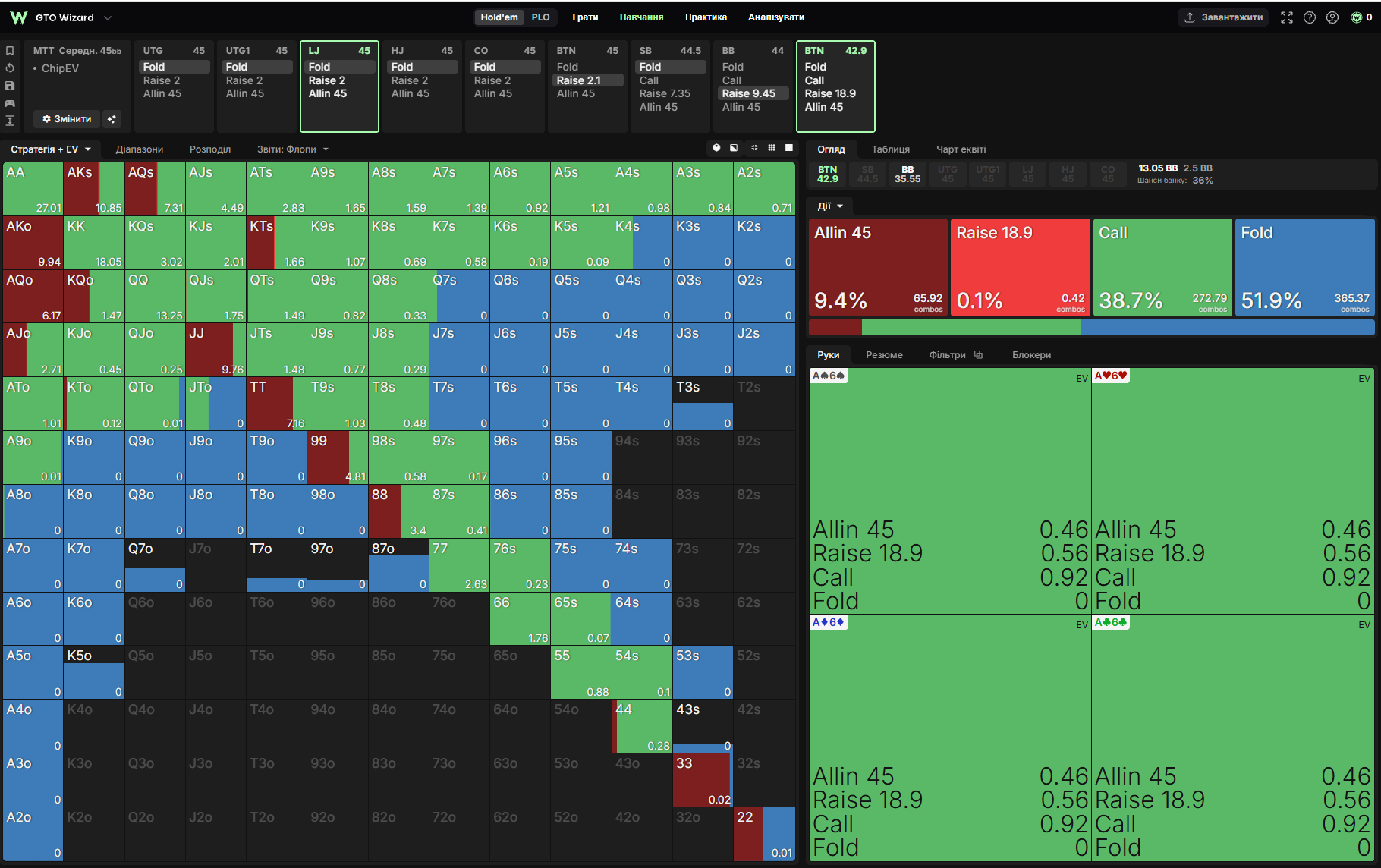
If the opponent removes strong hands from their calls, it changes their flop range. That does not mean we automatically bet every board. What matters is the board structure and how well our range and our opponent’s range connect with it.
Postflop play in 3-bet pots is a separate topic. The point here is the connection: preflop decisions determine the hands we both reach the flop with—and therefore the opportunities available afterward.
7. Squeezing: A Comfortable Call or More Profitable Aggression?
A different situation: BTN opens, SB calls, and we are in BB.
Why can’t SB casually call everything? Because there is still another player behind. And that player is allowed to squeeze.
There are more chips in the pot, and SB’s call does not guarantee a willingness to continue against a large raise. That can make BB’s aggression valuable. But SB’s calling range is not necessarily weak: some players protect it with strong hands.
In this 45 BB example, look at JTs and J9s. Attractive suited hands that make you want to call and see a flop. But a hand that looks good for calling does not necessarily have calling as its best use.
That is what I want to show with JTs: compare the EV of calling, making a non-all-in squeeze and shoving, not just how pleasant seeing a flop might feel.
Here are the actual numbers:
| Hand | Call | Squeeze to 9.97 BB | Shove 45 BB |
|---|---|---|---|
| JTs | 1.74 BB | 1.86 BB | 1.86 BB |
| J9s | 1.31 BB | 1.29 BB | 1.33 BB |
With JTs, both aggressive actions are worth 0.12 BB more than calling at the displayed precision. With J9s, shoving beats calling by only 0.02 BB. This is not a story about every shove being several times better in theory. It is about an attractive call not always having the highest EV. Next, we need to look at the responses those numbers assume.
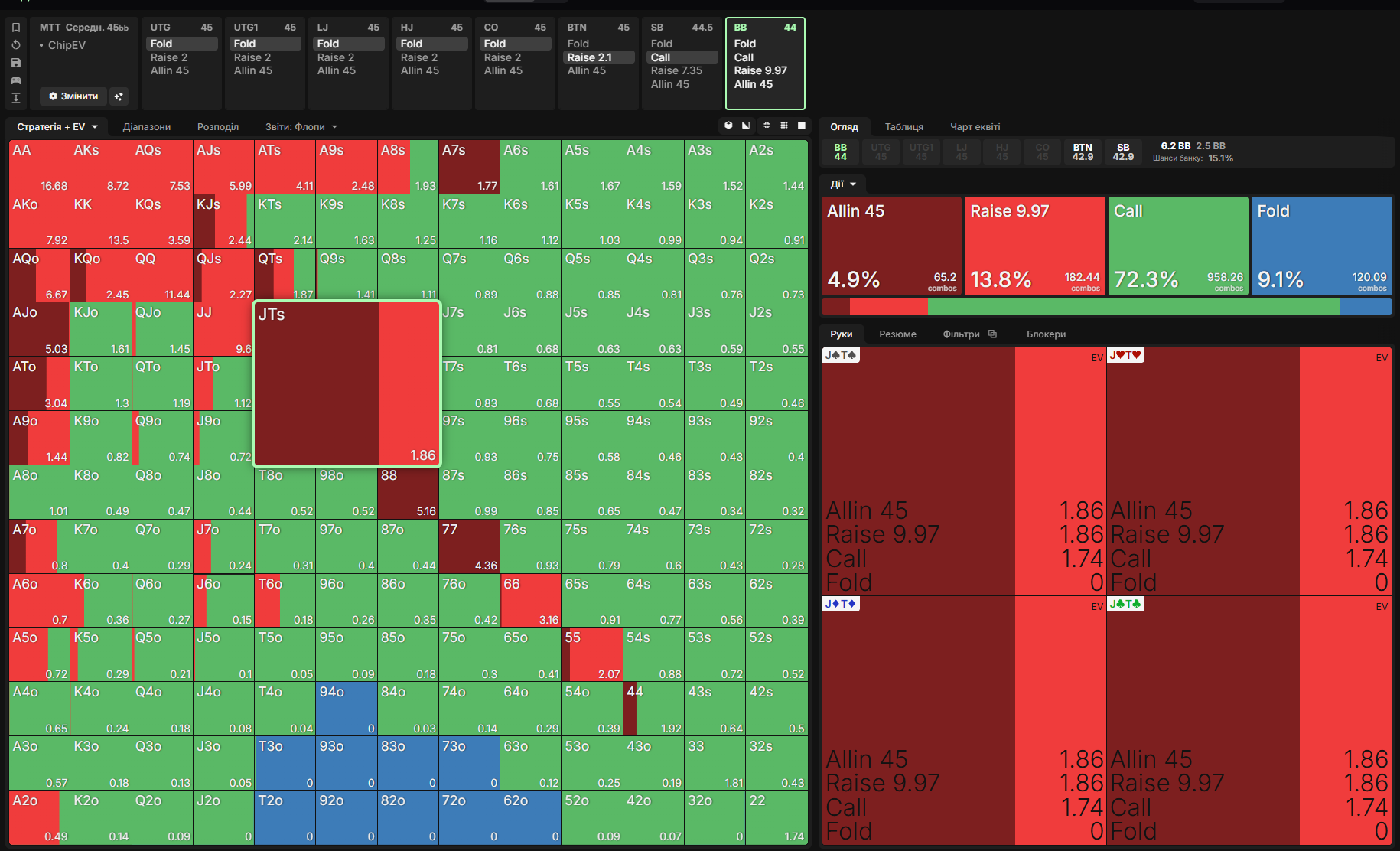
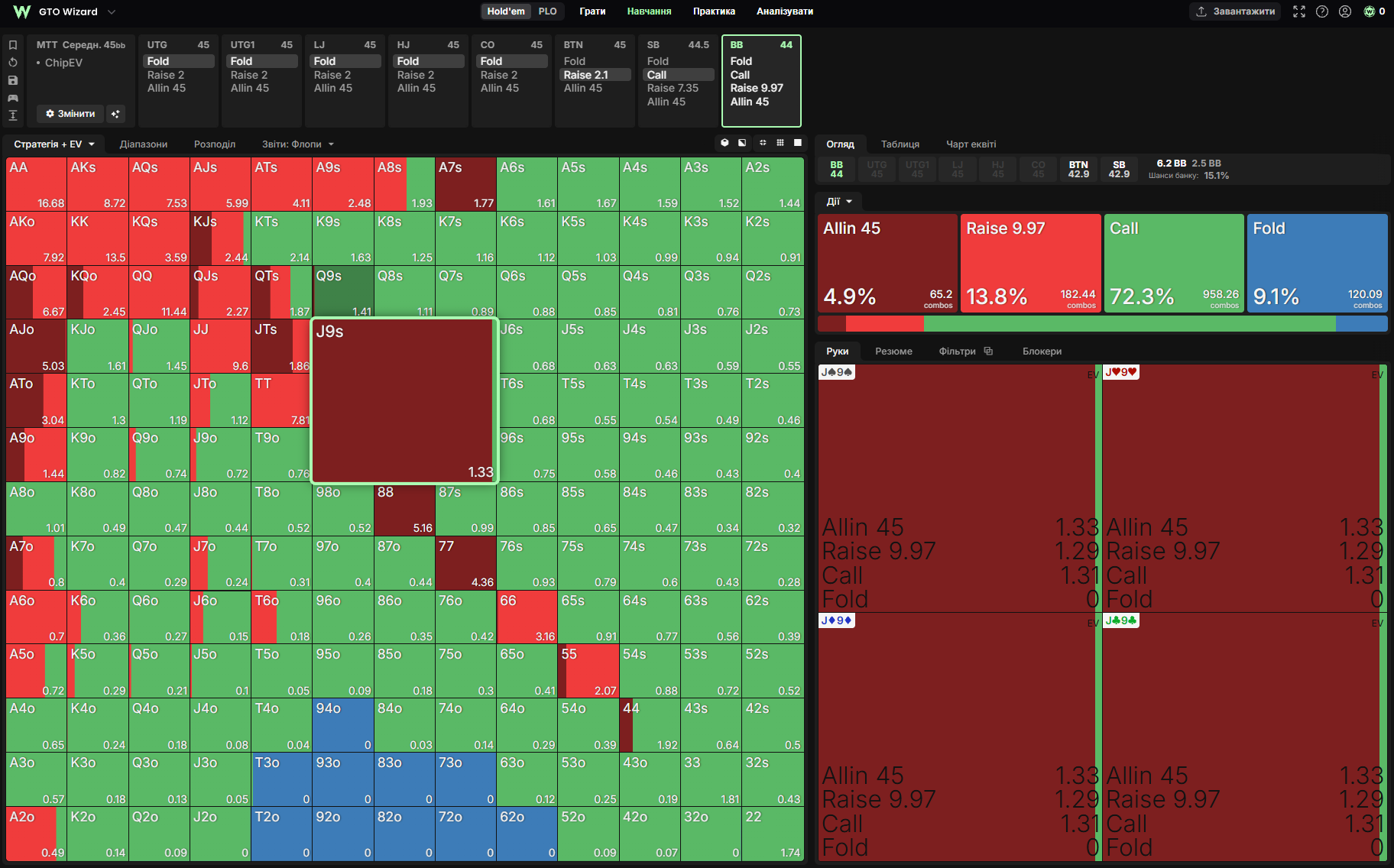
Shoving 45 BB with a hand like this can look ridiculous at first. “Why? I can just play a normal pot!” But let’s examine what we actually get in exchange for that large sizing.
Take J9s. If we just call, we keep hands in the pot that make pairing our cards uncomfortable. A hand like K9s has the better kicker on a nine; JTs or QJ has the better kicker on a jack. On some runouts, higher connected hands can also make a higher straight. “I have a nice suited hand” does not mean every time we connect will be comfortable—especially in a multiway pot out of position.
Now imagine shoving. If those hands cannot call it, we fold out the very opponents against whom some of our hits were problematic. They no longer realize their equity, and we do not have to navigate several difficult streets to realize ours.
Here is an important difference between a smaller squeeze and a shove. A smaller squeeze can get called by hands that dominate us; a shove folds out that part of the continuing range. We did not just increase the bet. We changed the set of hands our opponent takes further.
J9s makes this particularly clear: squeeze 1.29 BB, call 1.31 BB, shove 1.33 BB. The smaller squeeze is actually worse than simply calling here. Aggression alone guarantees nothing: the responses it generates matter. Keeping calls that are uncomfortable for our hand is one reason to examine the continuing range, not just the sizing.
And this is not a rule that shoving always beats a smaller squeeze: with JTs, they have the same displayed EV in our example. We are comparing a particular hand and the calls each sizing leaves in.
A shove generally creates more fold equity than a smaller squeeze. But we risk more chips, and when called we face a stronger range. That is why our hand needs to retain enough equity in that branch too. We cannot count only the pleasant part where everyone folds.
Now Look at Who Is Supposed to Call Us
The button’s response to this shove includes ATo, A9s, KQo and KJs. The displayed EV of our aggression already accounts for an opponent who can continue with those hands against 45 BB—with SB still behind them.
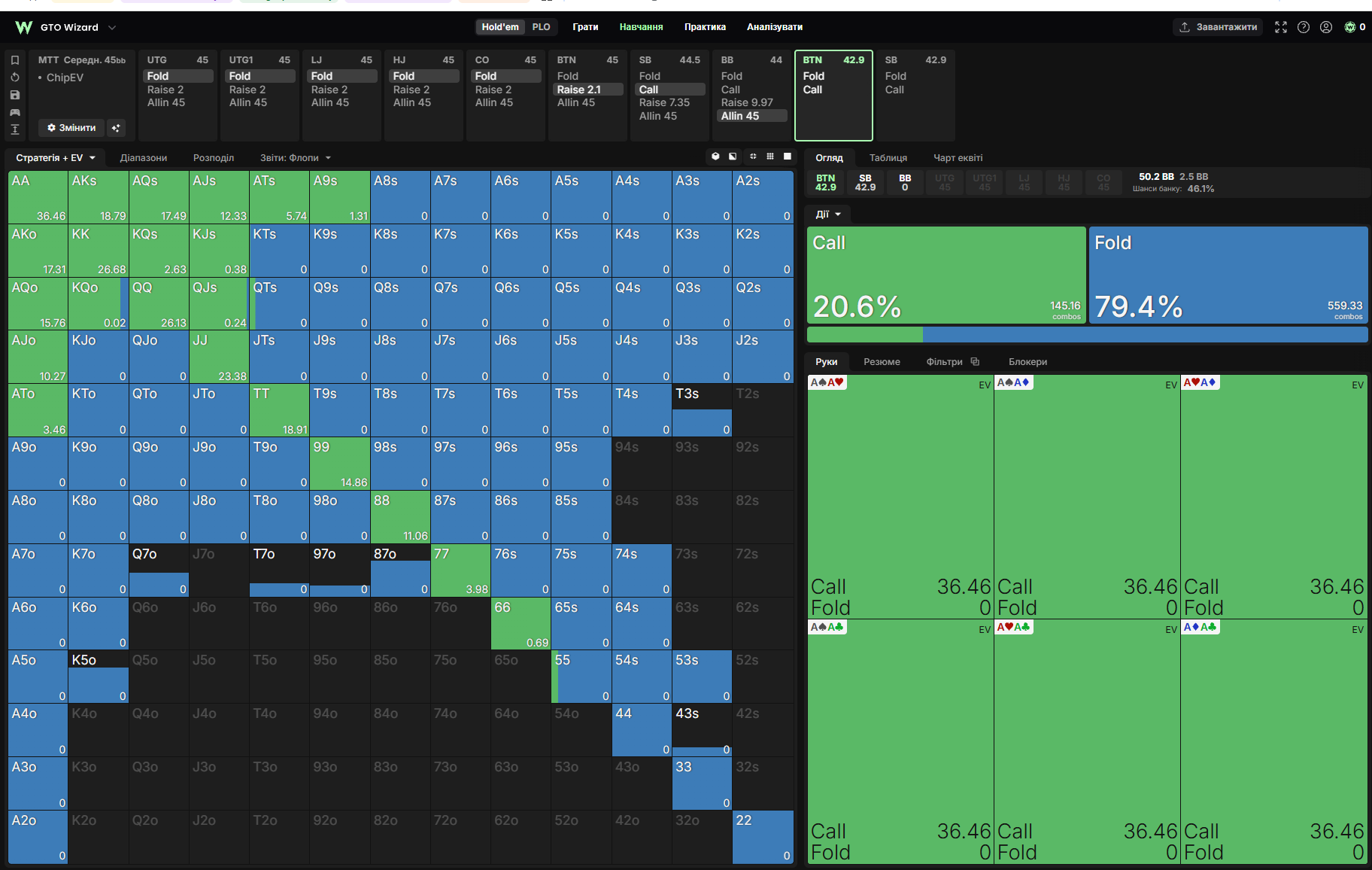
Here is my practical observation: I expect many opponents to fold these hands, rather than defend this way against 45 BB. This is where it gets particularly interesting for me. If they fold more than the solution assumes, our shove picks up the chips without a showdown more often and can become even more profitable.
How much more? That requires recalculating with specific ranges for both opponents. I will not invent a multiplier. But the reason is clear: we see decent EV even against a wide theoretical defense, and in practice we may also get additional folds. A small theoretical difference between calling and shoving does not necessarily stay small against a particular player.
Then why not shove our entire range? Because not every hand benefits from folding out so many hands and risking the whole stack. With some hands, we want to keep worse calls in or let the opponent shove themselves. With others, a smaller squeeze suits our blockers, our hand’s potential and how it can respond to a further raise. What we do when called matters too.
So this is not a simple chart of “strong hands squeeze small, weak hands shove.” For each hand, we compare what it folds out, what it keeps in, how much it risks and how much equity it retains against a continuing range. That is what separates calling, making a non-all-in squeeze and shoving.
And that is why “I’ll just see a flop” is not an argument by itself. It is easy to choose the option that feels less scary. It is not always the most profitable one.
8. Adjustments Work Both Ways
Wanting to exploit other players’ extra folds does not mean we should call every 3-bet ourselves just to avoid “being exploited.”
Against a player who 3-bets less often and with a stronger range than the solution, some marginal defenses get worse. Against a wide, well-constructed 3-bet range, we need an appropriate defense—not folds with everything that isn’t pretty.
Likewise in BB: the difficulty of playing out of position is not a reason to permanently fold every bottom-of-range hand. But if you currently realize their equity poorly, it is useful to recognize that and study it, rather than justify every expensive call with “the solver cell is green.”
Knowing the optimal range is not about switching off your brain. It is about understanding your starting point and how to adapt your game to a particular opponent.
Where to Start Right Now
I would not try to learn all of preflop in one evening. Take one clear situation: BTN versus the blinds at roughly 40–50 BB.
- Look at BTN’s opening range. Find a few hands around the boundary: which still open, which do not. Read the EV, not just the color.
- Look at SB’s and BB’s responses. Which hands do you almost never 3-bet, even though they appear there? Try to explain their role.
- Open the response to the 3-bet. What does it fold out? What stays in the calling range? Which strong hands continue by calling?
- Compare with a shorter stack. Don’t memorize another chart. Identify which properties of the hands have become more important.
- Review your hands. Where did you skip a 3-bet out of fear? Where did you open wider for a reason, and where did you just feel like it? Where did you apply a solution against a completely different range?
At the tables, add one simple habit: every time you play a hand, picture the ranges. What does your opponent roughly open? What will they fold to a 3-bet? What do you 3-bet yourself, and what do you defend?
At first, that picture will be very approximate. That is normal. You do not need to draw a solver matrix in your head in twenty seconds. You need to keep asking those questions—and with practice, you will get a better and better understanding of where the ranges begin and end.
Then you reach showdown and see a hand you did not expect at all. There is your next piece of work. Maybe your understanding of the baseline range in that situation was wrong. Or maybe the baseline was fine, but this particular opponent plays differently from what you assumed.
Make a note of the specific action and hand, and revisit the underlying theory. One showdown will not tell you how often they play that way, but it can already show you what to check. That is how ranges gradually stop being someone else’s colored chart and become your way of understanding a hand.
The Main Point
We can open wider when opponents do not punish our opens enough. And we should look more carefully for our own 3-bets, rather than give them that same freedom.
Not aggression for aggression’s sake. Not “apply pressure because they’re scared.” It is understanding where we deny their equity, where we realize ours, and where an opponent has made our decision more profitable.
Playing out of position is one of the keys to strong tournament poker precisely because it is easy to lose EV there without even noticing.
It feels good to be smart on the button. In the blinds, you have to do the work. And that is often the best place to start.