I promised to share my thoughts on 4-bets at around 40 BB. This is really not a story about one button. It is about whether we understand our whole range, rather than just the hand we have been dealt.
First, the terminology: throughout this article, “4-bet” means a non-all-in raise. I will call a 4-bet all-in a jam. They are different decisions, and we should not mix them up.
1. In position, do not make life harder for yourself
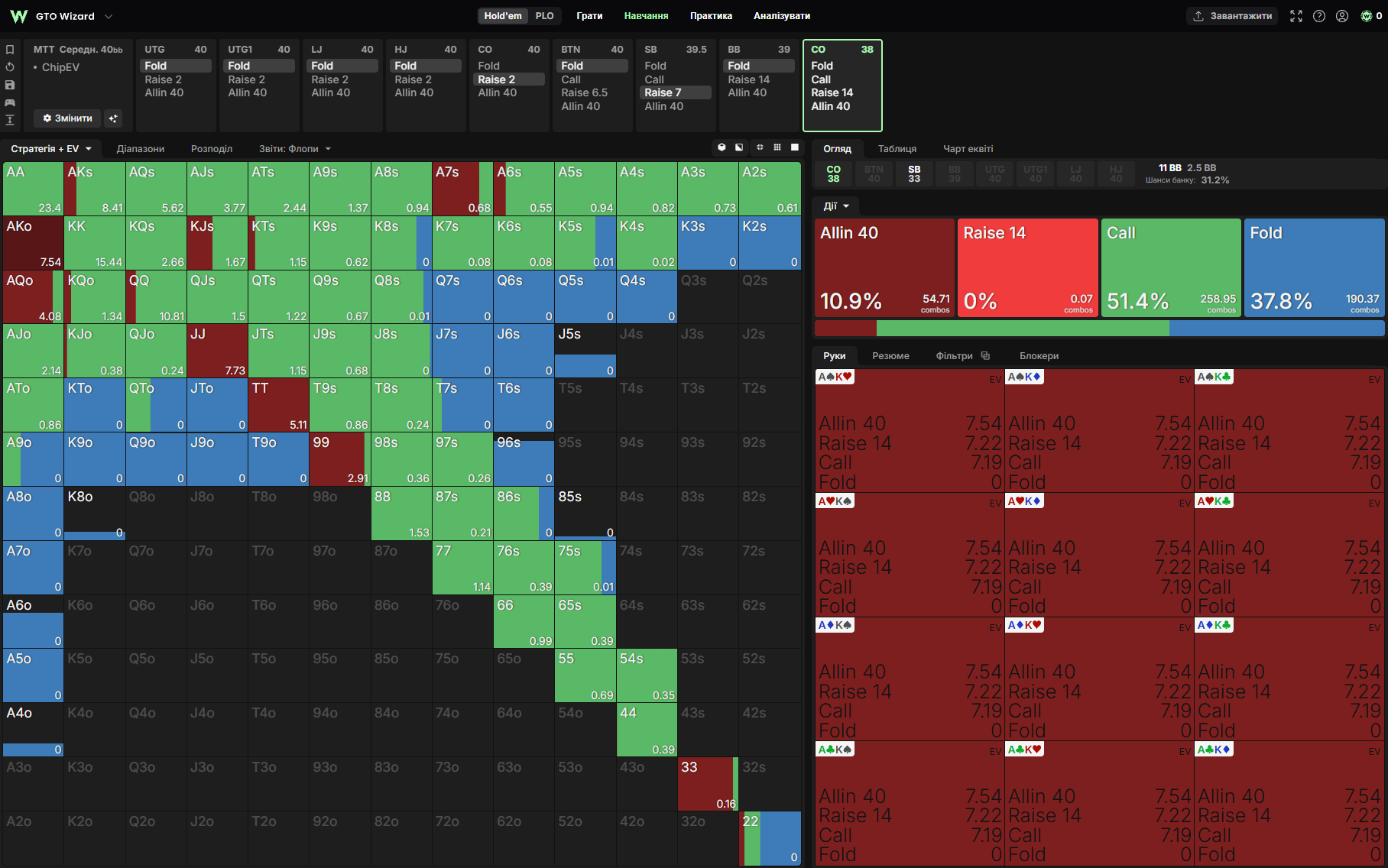
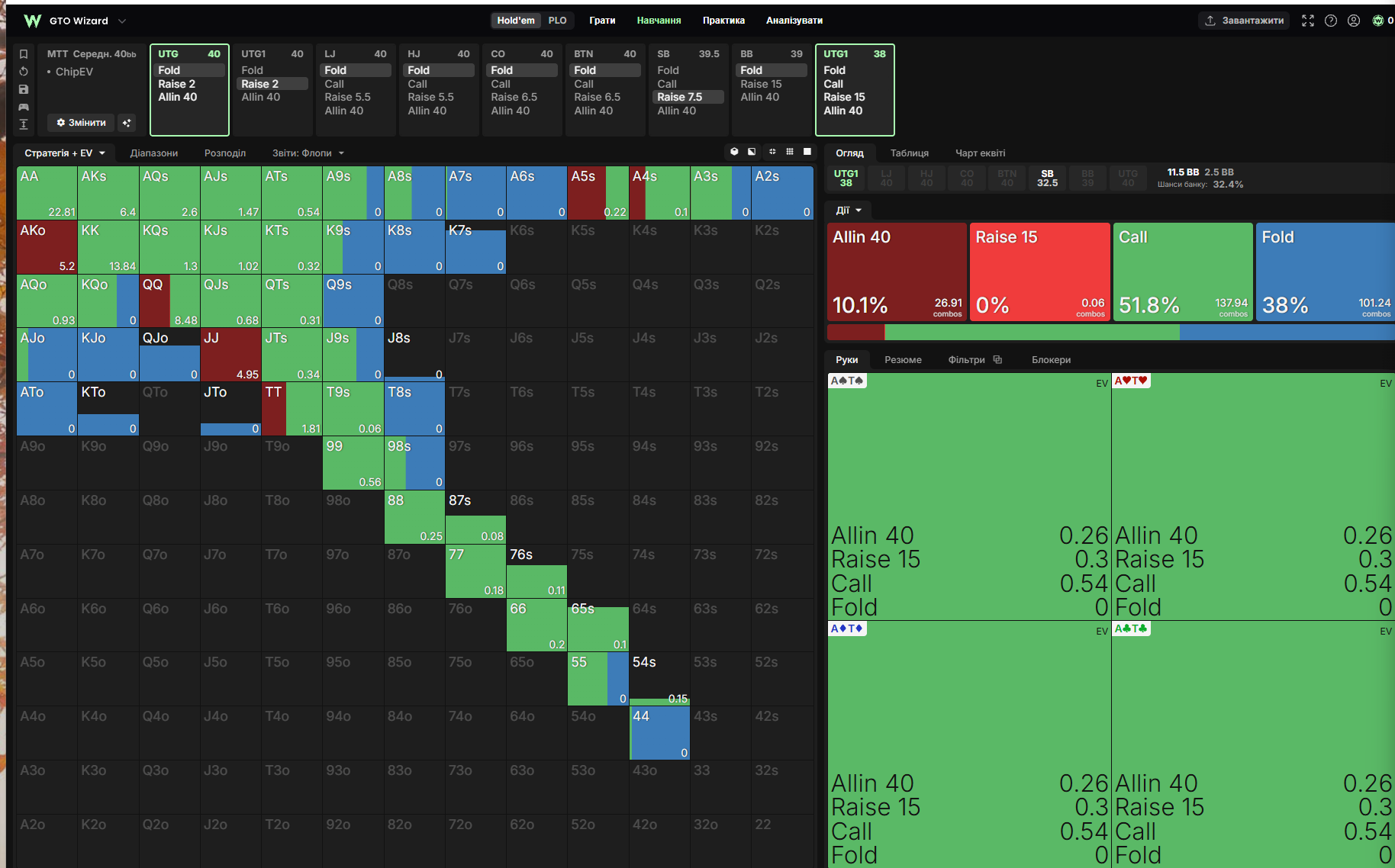
In the 40 BB spots discussed, when we open and face a blind 3-bet while retaining position, the strategy is simple: fold, call or jam. CO and MP are examples of in-position openers facing SB or BB, not an exhaustive list of positions. In the illustrated models, there is no meaningful non-all-in 4-bet frequency.
We call most of the hands we continue with and jam some. Calling certainly does not mean weakness: very strong hands remain in that range, including aces, kings and AKs in the examples discussed.
Why? We have position. Our opponent has already built the pot, and now has to play it first. Their range still contains weaker hands and bluffs that a raise might fold out.
Our call does not tell them, “I have something middling; go ahead and pressure me.” We could easily have AA. We know how we have built our range. Our opponent still has to work out which part they are facing.
That is what I like: we simplify our own decision without making life simpler for our opponent.
This is not a rule for every stack depth and situation. We are discussing specific 40 BB ChipEV examples, without ICM.
On mobile, swipe across the image or open the full-resolution original.
Open full-resolution original
On mobile, swipe across the image or open the full-resolution original.
Open full-resolution original
2. Out of position, there is a 4-bet. But kings need company
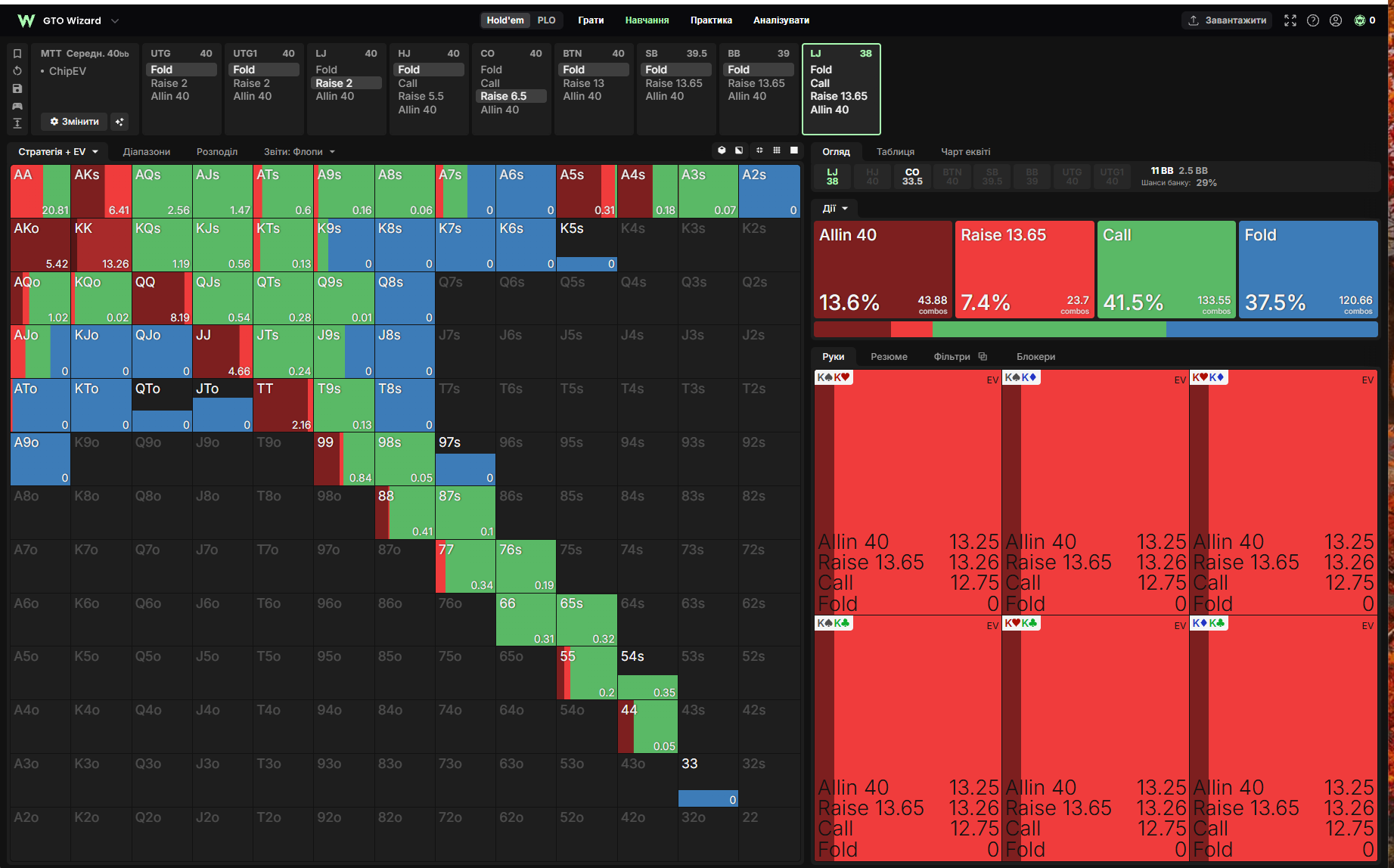
Hands are harder to play out of position, and in the first example the solver uses a 4-bet. KK is easy enough to understand. The question is not whether we can play kings that way. We can.
The question is: what else do you play that way?
In this spot, the 4-bet range contains around 24 combinations. For a simple illustration, take all six combinations of KK, half of AA and half of AKs. That gives us about 11 combinations. We are still a long way from the complete range.
The remainder does not mean “add 13 random bluffs.” There are other strong hands, a bluffing component and different frequencies. What matters is building the whole structure, not just collecting its most enjoyable pieces.
I play using frequencies. I am not claiming to reproduce the chart down to the last combination, but I try to understand which hands belong in each action and how often.
If you took kings from the solver and left all the awkward decisions to it, you are no longer playing the solver’s strategy. You are playing your own “finally, a hand” strategy 😄
On mobile, swipe across the image or open the full-resolution original.
Open full-resolution original
3. When someone 4-bets you, look at the person
On mobile, swipe across the image or open the full-resolution original.
Open full-resolution original
The same sizing does not mean the same range.
One opponent happily 4-bets premiums but barely finds any bluffs. Another has fallen so deeply in love with blockers that they click the button too often. Our response to them can differ.
See an unusual hand at showdown after a 4-bet? Note the positions, stacks, sizing and hand. That is much more useful than writing “weird player.”
One shown A5s does not prove overbluffing. One shown KK does not prove an absence of bluffs. But those observations gradually form a pattern.
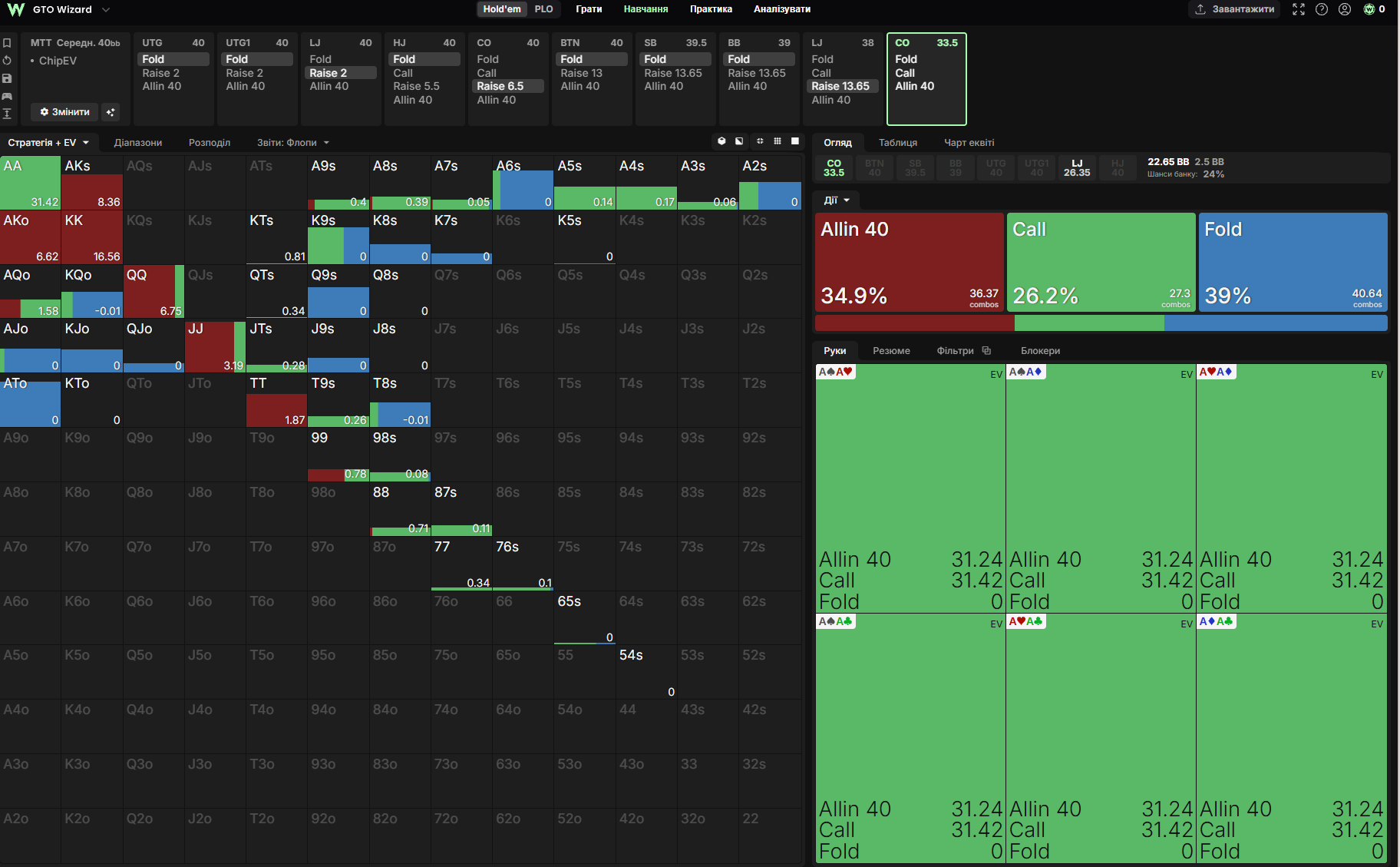
That is also why I am reviewing my own QQ jam. It appears in the calculation against a balanced range. Against someone who does not find enough bluffs, I want to examine calling more closely. Not because I happened to see kings this time, but because I have reasons to assess their range differently.
Calling does not automatically become better just because an opponent is tight. But jamming is not compulsory just because our cards say QQ, either.
4. A small in-position 4-bet: what does it tell us about the opponent?
When I am in the SB or BB and an opponent in position makes a small 4-bet at around 40 BB, my working suspicion is that their range is often weighted towards strength. That is an observation about people, not a law of poker.
Here, it is important not to confuse “a strong range” with “a range that likes every flop.”
Suppose it contains plenty of KK, QQ and JJ, but relatively few Ax hands. On an ace-high flop, those big pairs no longer look so comfortable. Some of our suited aces may make a valuable top pair. Holding an ace also reduces the number of AA and AK combinations our opponent can have.
But this is not a magic “Axs beats a 4-bet” button. We can be dominated by a better ace, fail to realise our equity out of position, or pay too much before the flop. So we assess the specific hand, the price of calling and what is actually in their range.
The point is not to call with any ace. It is to recognise which boards make a supposedly frightening range uncomfortable for its owner.
What to take away
- In the illustrated in-position spots, our choices are fold, call or jam. Do not add a 4-bet just because your hand looks good.
- Out of position, a 4-bet can be part of the strategy. But think through the bluffs and frequencies as well as the value hands.
- When facing a 4-bet, ask how this particular opponent deviates, and gather evidence rather than drawing conclusions from one showdown.
The main question is not “What does the solver do with my hand?” It is “Which range is it doing that against, and how closely does my opponent’s range resemble it?”
Go ahead and 4-bet your kings. Just make sure your strategy also works when you are not dealt kings.